Darjeeling, its violence, its hope

4 June 2010
Darjeeling, its violence, its hope

I feel sad today. A guy, a political leader to be a little bit more precise, has been assassinated in Darjeeling. In facts, violence has been raging in Darjeeling for 30 years. Tension is often tangible. And blood sometimes flows.

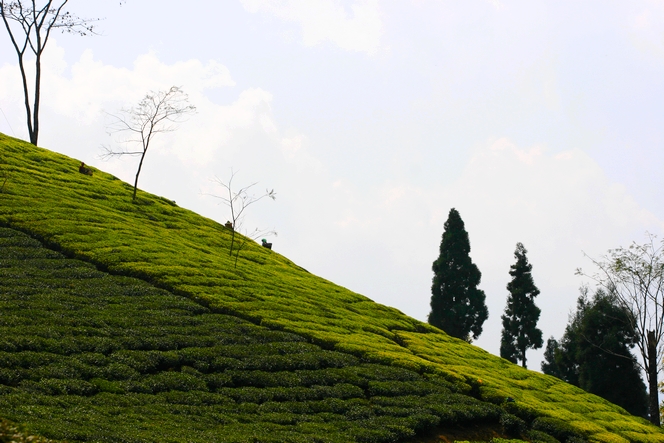
To explain the problem to you in a few words and in a way that is much too brief, Darjeeling, where mainly Indians of Nepalese origin live, is located at the extreme north of the Indian State of West Bengal. In this particularly backed-off spot, roads are in a disastrous state, water is scarce, infrastructures are generally in an apalling state. Thus, many inhabitants of these mountains wish to create a new state called “Gorkhaland” within the Indian Union. And this, in order to stop keeping waiting for money that never comes from Kolkata and to enjoy an easier life like the Sikkim neighbour who depends directly from the Central State, namely Delhi.

I hope that they will be able to solve these problems using reason rather than violence. Couldn’t the inhabitants of Darjeeling be given normal life conditions, suitable roads, running water and some autonomy so that they can decide what is best for themselves?

Between political leaders who don’t do anything, those who are corrupted, those who make promises the day before elections and forget them the following day, those who divide instead of assembling and those who arouse masses, people would be in a grief to decide who to confine their destiny to.

I choose this adorable toddler, coiled up in his mother’s arms with his life in front of him, to wish Darjeeling, its mountains I love so much and these Nepalese people who are dearest to me, a better future.

Share on Facebook. Tweet this!

China, birthplace of tea

1 June 2010
China, birthplace of tea

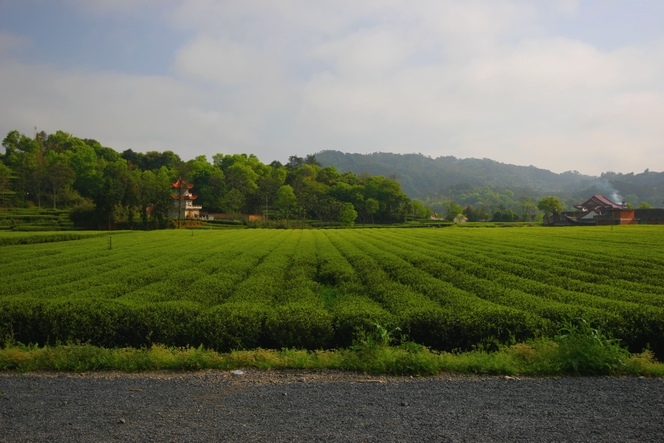
I have just acquired the first flush green teas from China for Le Palais des Thés.
China was the first country in the world to produce tea. It has been growing there for thousands of years. In comparison, India and Sri Lanka have only been producing tea for 170 and 140 years, respectively.

The legend about tea drinking goes back to Emperor Chen Nung, more than two thousand years ago. He had apparently stopped beneath a shrub to take a nap, a bowl of hot water beside him, as it was his custom. A gentle breeze then came up and removed from the shrub a leaf which dared to settle in the imperial bowl. We can imagine a host of devoted servants rushing forwards to change the dirty bowl, rinse it, dry it and refill it with nice clear, rippling water. But the Emperor, just from a sign of the hand, told his servants to stand back, and with a single index finger raised towards the sky, he said these few words:

“From what the Sky sends Us,
Is born harmony in Us.”

The Emperor then lifted the bowl to his lips. He tasted, he drank. He appreciated. He then asked what the name of the shrub was.

And so tea was born.

Share on Facebook. Tweet this!

Tea plucking by men in Nepal

28 May 2010
Tea plucking by men in Nepal

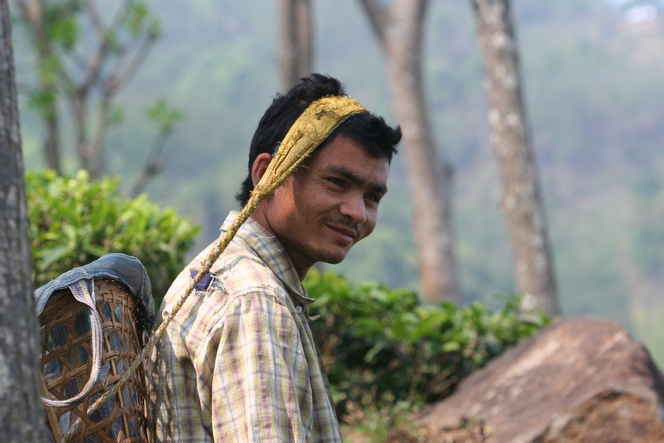
In some regions of the world, tea plucking is only done by women, while men are responsible for other jobs. It’s the case in India and central Sri Lanka, where men employed on the plantations tend the soil and prune the tea plants. Some people will tell you the reason for this is probably that women are more nimble-fingered and take better care of the fragile and precious leaves. 

But most of the time, like here in the north of Ilam Valley, eastern Nepal, opposite Darjeeling accross the border, the village men and women do the same tasks, including tea plucking. It is also the case in China and Taiwan. And in Japan, it is not rare to see a man carefully plucking the tea leaves and a woman behind the wheel of a tractor.

Is there really a reason for these practices? Well, let’s say that where the British used to be and where there are large tea plantations, the roles of men and women are different and the work is not always shared out in a way that seems fairest to us.

Share on Facebook. Tweet this!

Tea plants under canvas shaded from the sun

25 May 2010
Tea plants under canvas shaded from the sun

With the wonderful weather we’ve had in France over the past few days, we have to remember to protect ourselves from the sun.
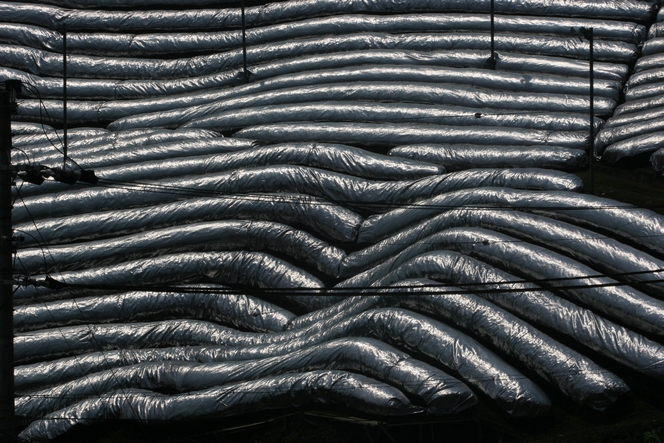
Did you know that tea plants also need protection sometimes? Actually, this only happens in Japan, where there are two categories of tea: “light teas” and “shade teas”. “Light teas” (Sencha, Bancha, Tamaryokucha) are harvested and processed from bushes explosed to sunlight, whereas “shade teas” (Gyokuro, Kabuse, Tencha) are made from tea plants growing in he shade, or even in darkness. As a consequence, the plants are under stress and react to it by by taking more nutrients from the soil. This unusual treatment gives a well developed, smooth and full flavour (which the Japanese call umami) without any bitterness. In other words, a delight.
 
I took this photo near Nara. I was attracted by these neat rows of tea plants covered with a silvery-black canvas, glimmering in the sun. I stopped to watch them, fascinated by their dark brightness, as you might stop in the moonlight to gaze up at the stars.

Share on Facebook. Tweet this!

Fans in the tea fields

21 May 2010
Fans in the tea fields

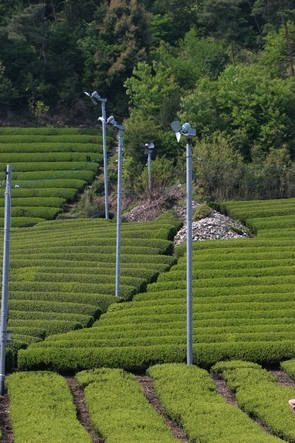
There are some curious sights in the tea fields of Japan. Multitudes of fans perched on top of posts ruffle the rows of green foliage, their metallic appearance contrasting with the soft shapes of spring. What are they for? To create a breeze when the sun gets too hot? Not at all! In fact, the fans are used in the depths of winter, when they are switched on to stir up the air and prevent layers of cold air stagnating above the tea plants. This cold layer could damage the shrubs, or slow down their growth.

Share on Facebook. Tweet this!

Tea harvesting is mechanized in Japan

18 May 2010
Tea harvesting is mechanized in Japan

In Japan, tea harvesting is highly mechanized. In the Shizuoka region, which is on the Makinohara plateau and where Sencha teas are produced, you come across some machines that have a very strange way of talking to the tea leaves. And yet these sharp, deft steel fingers don’t harm them. With extreme precision, this strange harvester takes just the most tender parts of the shoots.

Share on Facebook. Tweet this!

Tea trees looking like traffic lights

14 May 2010
Tea trees looking like traffic lights

At New Vithanakande (in the south of Ratnapura, Sri Lanka), to keep the tea plants at the right height, the trees serve as a kind of traffic light system: if you see green, the tea plant is not too high, if the green disappears it is the orange that shows, and the plants need to be cut lower, and if only the red shows, things have got out of hand!

Share on Facebook. Tweet this!

How to forge good business relations in Japan ?

11 May 2010
How to forge good business relations in Japan ?

There is a Japanese tradition that is completely unrelated to tea, but I like it so much I want to tell you about it. It is about the famous onsen, the hot springs.
In a volcanic country like Japan, with all that matter fermenting together underground, it is no surprise that boiling water erupts from the ground everywhere. There are many hot springs in the land of the rising sun.

The water temperature is so high that even in the middle of winter, it can make you hot even when your shoulders are exposed to the cold air.

The onsen are an extremely popular destination among the Japanese: they bathe in them to relax, rest and even cure themselves. They spend weekends, even entire vacations, in them. You go to the onsen with your family and your friends. When you go with a client, or a business contact, it is known as “hadaka no tsukiai”, or “naked communion”. The Japanese believe that bathing together, naked, is a way of showing yourself as you really are, with nothing to hide. This is important, they say, if you want to forge transparent business relations.

Here, near lake Tazawa, the deepest in the country, I am taking part in “hadaka no tsukiai” with Koichi Fujiki, a producer of tea canisters. We want to work together, for a long time, to be able to trust each other in business, without hiding anything. And this is how you do it!

Share on Facebook. Tweet this!

How to forge good business relations in Japan ?


How to forge good business relations in Japan ?

There is a Japanese tradition that is completely unrelated to tea, but I like it so much I want to tell you about it. It is about the famous onsen, the hot springs.
In a volcanic country like Japan, with all that matter fermenting together underground, it is no surprise that boiling water erupts from the ground everywhere. There are many hot springs in the land of the rising sun.

The water temperature is so high that even in the middle of winter, it can make you hot even when your shoulders are exposed to the cold air.

The onsen are an extremely popular destination among the Japanese: they bathe in them to relax, rest and even cure themselves. They spend weekends, even entire vacations, in them. You go to the onsen with your family and your friends. When you go with a client, or a business contact, it is known as “hadaka no tsukiai”, or “naked communion”. The Japanese believe that bathing together, naked, is a way of showing yourself as you really are, with nothing to hide. This is important, they say, if you want to forge transparent business relations.

Here, near lake Tazawa, the deepest in the country, I am taking part in “hadaka no tsukiai” with Koichi Fujiki, a producer of tea canisters. We want to work together, for a long time, to be able to trust each other in business, without hiding anything. And this is how you do it!

Share on Facebook. Tweet this!

The delicate art of making tea canisters from cherry bark

7 May 2010
The delicate art of making tea canisters from cherry bark

During my recent journey to Japan which led me to the north of Honshu at the extreme south of Kyushu, I visited for the first time a lovely city deeply nestled among mountains covered with woods. This city is Kakunodate, located nearby Akita (I’m giving details for the people, like me, who enjoy poking their nose on a map and dream while pointing their finger on imaginary roads).

In Kakunodate the tradition of wood work is still carried on. But not any wood ! Here they are only interested in cherry tree. Objects are carved in its bark, or, in other words, this beautiful bark is turned into a smooth and delicate leaf just like a precious parchment and is then pinned against the desired object:  a tea canister for example.
It is a very slow and meticulous work: once the wet season is over, a sample of bark is taken (approximately ten meters above the ground) and is then left to dry for no less than a year ! This leaves enough time to carefully think about its destiny…

With the help of a small flat-iron, this worker smoothly presses against the bark, after having coasted its back so that it perfectly sticks to the tea canister’s body. Of course, before that, she slowly polished the bark with great care,  using the blade of a knife in a repetitive movement  so as to make it surprisingly soft.

I’m admiringly watching her, in the silence surrounding her workshop. Once the tea canister is finished, she strokes it and holds it out to me with a discreet pride and I’m thinking about the beautiful Japanese green tea which will be a perfect case for it.

Share on Facebook. Tweet this!