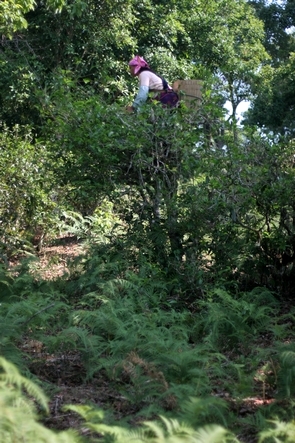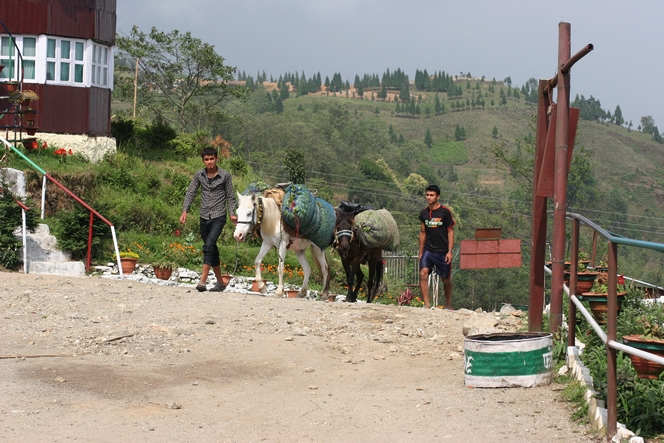
In Ilam (Nepal), horses are still used to transport tea leaves. These two young men have walked for two hours to reach the place where the tea is processed, so they can sell their fresh tea leaves. Hanging against the horses’ flanks are sacks weighing around 20 kilos each. They try to avoid making this long journey on a rainy day, otherwise the cargo can get damaged as it begins to ferment.
From plant to cup
The tea tree is maintained at a convenient height
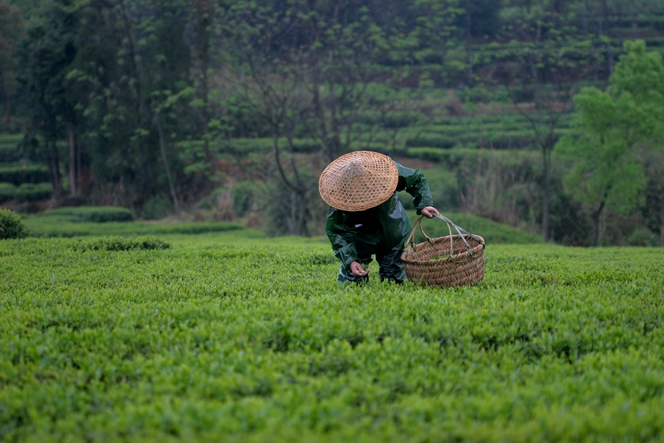
Since the tea leaves are picked constantly, like here in the Gao Shan region of China, litteraly meaning “High Mountain”, the tea tree cannot grow any bigger. It is maintained, harvest after harvest, at the most convenient height: not too low, so the task is not made more difficult, and not too high, to stop parasites developing at the base of the plants. The tea trees are kept at between knee and waist height, depending on the region and the climate.
“High grown” and “low grown” teas
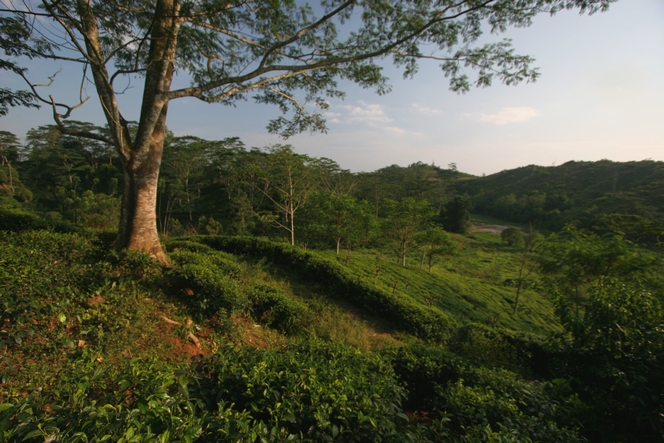
In the south of Sri Lanka the altitude is low and the vegetation very dense. The tea plantations, which are small in this region, are surrounded by luxuriant vegetation. The teas produced here are known as “low grown”, unlike the teas grown in the very mountainous centre of the island, called “high grown”. But take note! A low grown tea is not of inferior quality, on the contrary. Because of the greater care taken when processing the tea leaves of low grown plants, they often achieve better prices at the Colombo auctions.
Protecting tea plants from the heat
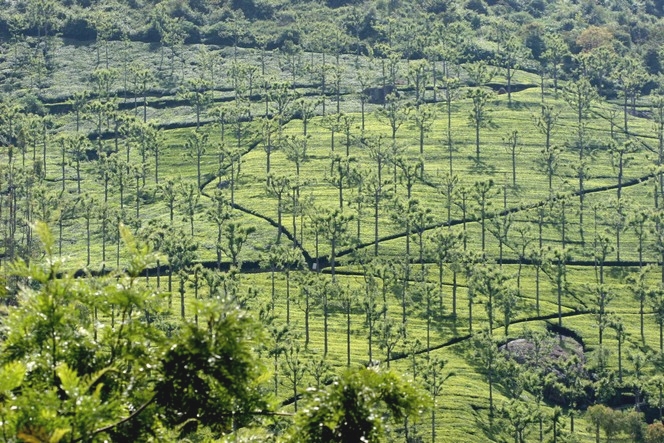
As I was mentioning it in a previous post, tea requires delicate care. Tea plants appreciate a bit of shade, especially if the sun is strong. In the hottest regions, trees are planted to help the plants and give them some cover, like here in the Nilgiri mountains (India).
Contrarily to Darjeeling and Assam, the tea produced in the region is mainly black crushing-tearing-curling (CTC) tea and harvesting occurs all year round. This straightfoward process applied to low quality leaves makes a tea with little taste, often found in tea bags…
So, not very good teas in this region, but beautiful landscapes, charming little villages (Coonoor, Munnar), gardens growing spices, hills covered with cardamom plantations… An appealing region to say it short.
Cultivar is to tea what grape variety is to wine
All tea plants are members of the Camellia Sinensis species, but there are a great many cultivars, each with their own unique characteristics and qualities. Some are more resistant to the cold, for example, or to certain parasites. Others produce a more abundant crop.
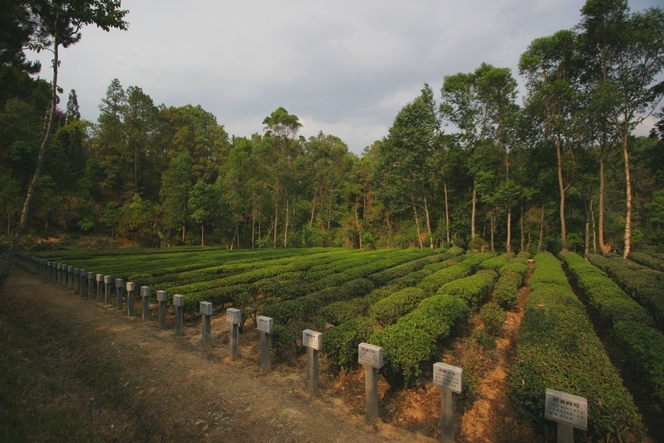
Here, in Feng Qing, near Lincang (China), tea planters breed a wide variety of cultivars in order to experiment with grafting, for example, to produce new hybrid tea plants.
I visited this tea garden last year between two tastings of Pu Er, the main tea found in the region and manufactured from a cultivar called “Da Ye” (big leef).
Moreover, it’s here, near Lingcang, that the old tea and horse exchange road comes by.
Tea growing under British influence
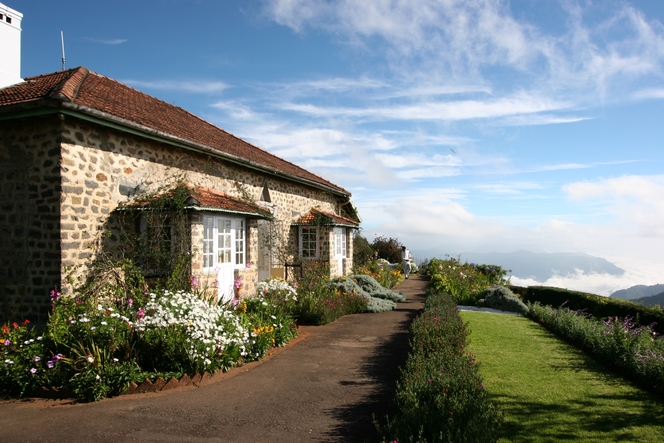
It was the British who introduced and organised tea growing in India. They created large tea plantations called tea estates. Keen to retain the comforts of home, they built charming, typically British cottage-style houses.
When I visited the Thiashola Tea Estate in India, I was lucky enough to be able to stay in this tea grower’s house. It dates back to the nineteenth century. Nestled on the edge of the jungle, it overlooks the tea, the clouds and the Deccan plain. What a joy to arrive there, surrounded by flowers, to contemplate this unique landscape and enjoy its rare silence. A feeling of being at the edge of the world. Total isolation. The moment I loved best: at dawn, pulling on a sweater, going outside and sitting on the front steps, a bowl of steaming tea in my hands, admiring the glowing red sky as the sun rose.
I have just bought the first Darjeeling flush
The first Darjeeling flush is delayed for the third consecutive year. This time, the tea plantations suffer from drought: it hasn’t rained in Darjeeling since October 10th, 2009. Surprisingly, the sky is covered with clouds, the Kanchenjunga cannot even be seen. In the few irrigated plantations, the chill prevents the tea leaves from growing. Temperatures are still very low at night and I sleep with a hot-water bottle at the Planters Club!
So far, most of the tea gardens have only had one harvest (DJ1). Normally, they should have harvested enough tea leaves to make around ten lots (DJ10).
The first lot of Darjeeling harvest at North Tukvar has a floral bouquet of much greater quality than other plantations, even the best ones like Puttabong and Singbulli. I didn’t hesitate to buy this tea which is to arrive in Paris this week-end. It’s a clonal mixture of various cultivars. I don’t usually buy tea at the beginning of the harvest, but if it doesn’t rain in the next coming ten days, the amount available will be scarce.
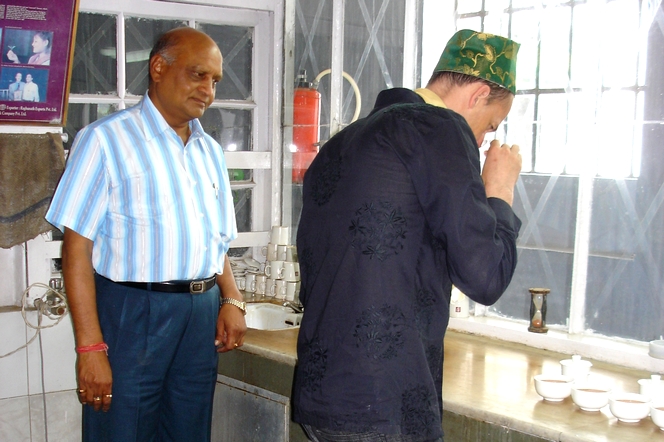
This year, it might be is very small in comparison with previous years. It doesn’t seem to particularly worry the responsible of Puttabong and North Tukvar, Mr Somani (on the photo), who told me with his Indian-like fatalism: “If there’s a storm tea will grow very fast, only gods know…”.
Tea bud and fine plucking
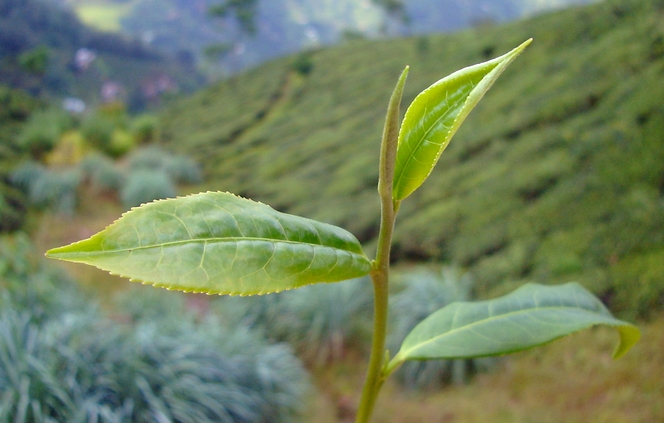
Let’s get back to tea and how it is harvested. When the camellia is fully grown, the youngest leaves are plucked. In this photo you can see what is known as the “fine plucking”: the removal of the bud and the next two tea leaves. This is almost the best thing that can be done with tea: it’s a symbol of perfection.
Imperial tea plucking takes place in China in May. It is a very exceptional occurrence and only takes place in those rare villages that are said to produce the most famous teas. As for the plucking of the bud alone, this is sold under the name Silver Tips or Yin Zhen; it is extremely subtle and needs to be appreciated by connoisseurs. From left to right: fine plucking, imperial plucking and the bud alone.
Tea plants around Mount Fuji
There are many tea plantations around this Japanese peak, but it’s not easy to find a spot where you can only see the tea garden with Mount Fuji in the background. You have to drive around the narrow back roads, keep turning round… It requires patience. And when you reach your goal, don’t expect solitude: the Japanese are keen photographers, and there is a real cult attached to their favourite volcano… There were at least a dozen Japanese around me when I took this photo.
Rows of tea plants in Fuding
The purpose of my blog is to allow you to take part in my travels. I spend a large part of the year visiting tea plantations. The landscapes are often magnificent, the people I meet very welcoming. I’m learning more about tea all the time.
It is these landscapes, these people, this knowledge I’d like to share with you, if you wish. This blog makes a lot of sense to me: what’s the point in doing your dream job if you don’t share it?
I love this photo taken near Fuding, in Fujian province, China. I like the gentle movement of the rows of tea plants. And this beautiful house, so peaceful, buried in the greenery. I didn’t want to leave.