The little Darjeeling train manoeuvring in the street

17 February 2012
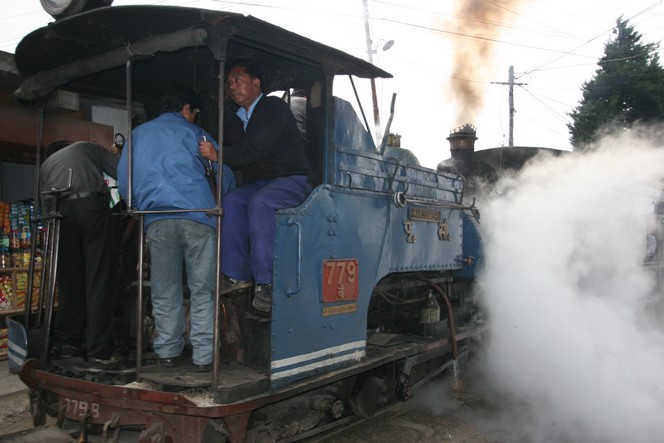
The little Darjeeling train manoeuvring in the street

I stand back to let the little Darjeeling train past, the famous “Toy Train”. I do so quickly as it isn’t always easy to know which direction it is travelling in. The whistle blows and amidst a terrible racket, here it is starting to gather speed. It is manoeuvring right in the middle of the street, surrounded by people and traffic. We can guess from the tense face of the driver, who has his back to the engine and is steaming straight ahead, that it isn’t an easy task.

Share on Facebook. Tweet this!

The tea fields need looking after in winter too

14 February 2012
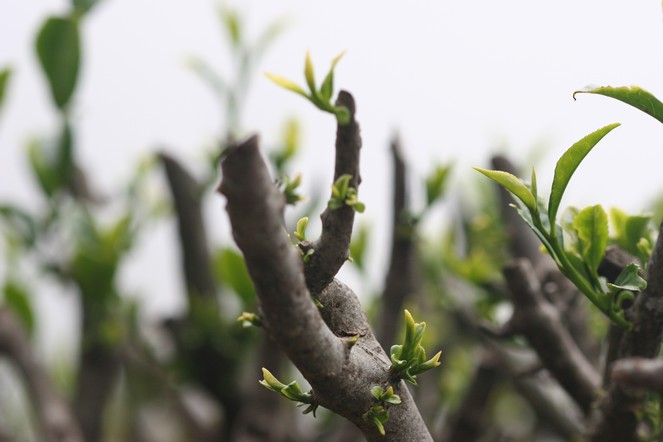
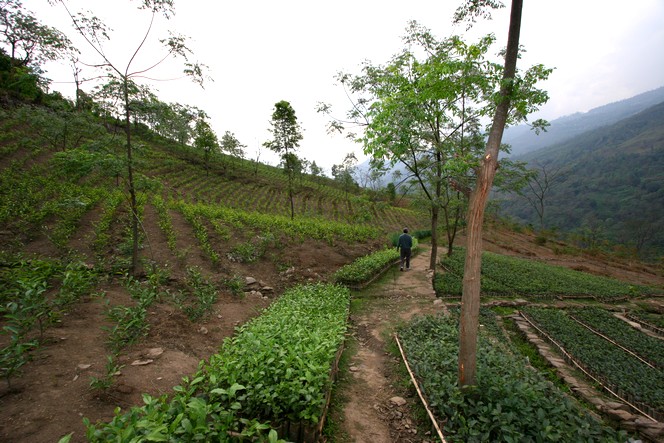
The tea fields need looking after in winter too

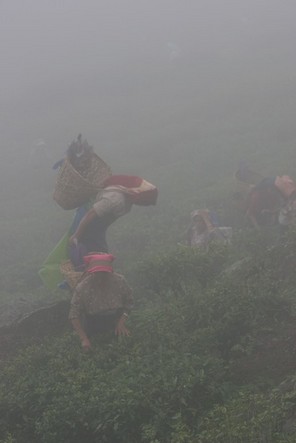
During the winter months, tea plants grow very little, if at all. So this is the time to work on maintaining the land, such as the cuttings garden, for example. This is an area planted with bushes from which cuttings are taken. The plants are therefore chosen with great care. Each parent tea plant, like here in the cuttings garden at the Namring Tea Estate (India), can provide between 50 and 300 cuttings a year.

Share on Facebook. Tweet this!

The lion’s dance in the Chinese New Year festivities

10 February 2012
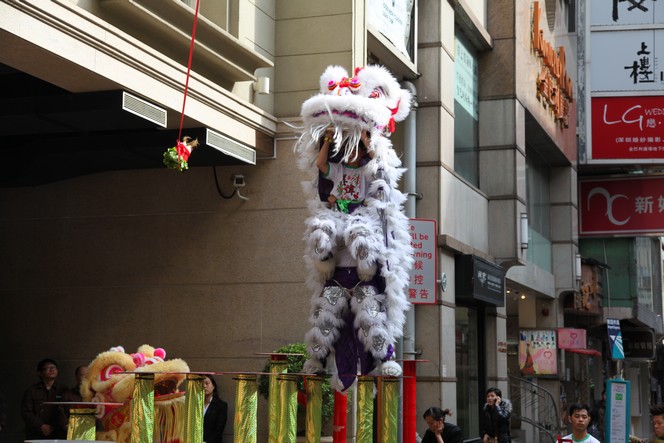
The lion’s dance in the Chinese New Year festivities

I’ve witnessed a curious spectacle in the streets of Hong Kong on many occasions in recent days. A large, peculiar-looking animal performs all sorts of contortions and dances, surrounded by percussionists playing the cymbals and other instruments. Then it rises up on its hind legs and stands very tall, to the roar of the drums which gains in intensity to increase the air of excitement. It then gulps down a bunch of vegetables hanging high in the air, before spitting out the leaves a few moments later.

The lion’s dance is part of the Chinese New Year festivities. In Hong Kong, no shop or hotel misses out on a visit from this strange creature. Inside the beast are two Gong-Fu experts, and this exercise demands great skill.

Share on Facebook. Tweet this!

How to warm up with tea

7 February 2012
How to warm up with tea

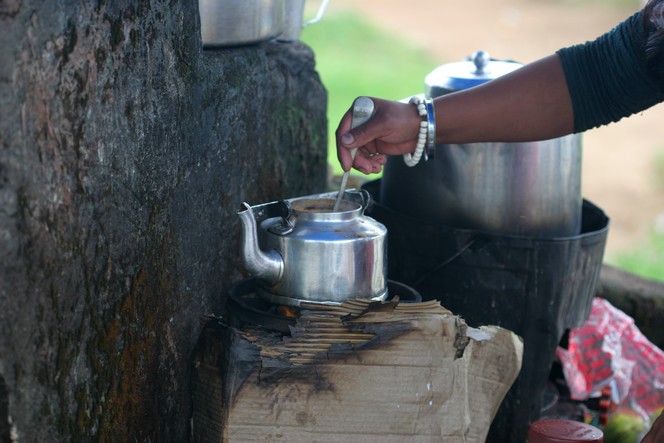
With the cold you are battling in France at the moment, you need to keep warm. Always have to hand a kettle filled with fresh water. A singing kettle, for example, whose song warms the soul and lifts the spirits.

A song calling you for tea.

Everywhere in India you see tea vendors in the streets and on the roadsides. With a kettle purring over what are sometimes simple wood fires, they are always busy. On the roads of the Himalayas, they might set up stall on the corner of a rock. You squat down next to the vendor and take your time sipping the scalding blend of tea, milk and spices. You simply take time to do yourself some good.

Share on Facebook. Tweet this!

Yabo cha fang: a tea house in Hong Kong

3 February 2012
Yabo cha fang: a tea house in Hong Kong

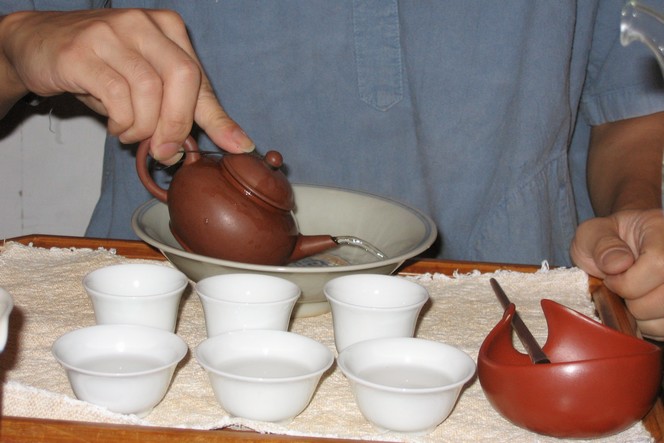
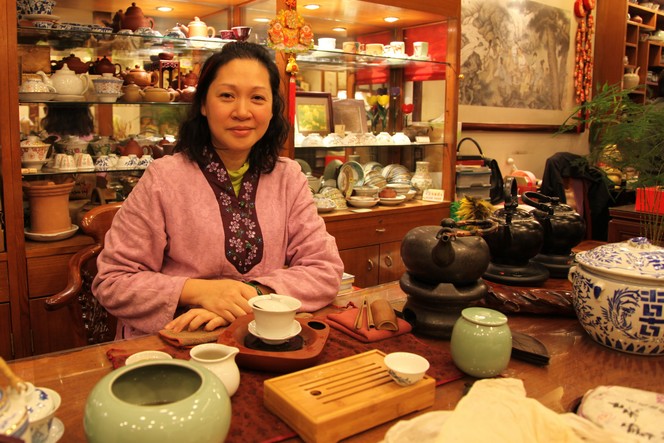
When I arrive in Hong Kong I go straight to one of the tea houses; they’re such havens of peace. People go to them to buy old pu er; traditionally, the vendor sits opposite you and, after looking at you for a few moments, puts the water on to boil. They break off a piece of the tea cake, and you talk together about this and that, and about tea of course. You compare the different waters, because the same tea is infused several times over. From one tea to the next, one cake to the next, the minutes – sometimes the hours – pass by, interspersed with the sound of our little gulps: here, tea is drunk from tiny cups, like those used in the Gong Fu Cha.

A student of Yip Wai Man, Eliza Liu has one of these tea houses in the Mongkok district, and teaches her many devoted customers all about tea in an informal manner. Yabo Cha Fang is a friendly place with a special atmosphere, a mysterious charm, like Eliza’s smile which I have captured here, as she crosses her hands in the style of the Mona Lisa.

Share on Facebook. Tweet this!

An olfactory journey in the streets of Hong Kong

31 January 2012
An olfactory journey in the streets of Hong Kong

Walking through the streets of Hong Kong is an olfactory journey. In this city where street food is sold on every corner, the many stalls – there’s one every ten metres or so – give off copious, diverse and unusual smells: duck skin crackling over the heat, sizzling lumps of fat, garlicky vegetables frying in the wok, caramelised pork. There are fried noodles, fritters and dim sum of all kinds.

With all the greasy smoke, the stalls overflowing with delicious food, it’s a real wake-up for the senses. Whatever the time of day or night, it makes you want to dig into a big bowl of steaming noodles.

Nowhere as much as here, in Hong Kong, in this city that never stops and that dazzles with a thousand neon lights, have I ever had such a strong sense that man was put on this earth to eat.

Luckily, there are also tea houses where you can take a seat and follow the owner’s advice, and taste with him a few leaves of Pu Er, delicately broken off an old tea cake. Then you can take time to savour your tea, and think about this island and its hyperactive inhabitants who consume with such frenzy.

Share on Facebook. Tweet this!

The lifespan of a tea plant: between 30 and 50 years

27 January 2012
The lifespan of a tea plant: between 30 and 50 years

Everything comes to an end. When a tea plant no longer produces many leaves, it is replaced. The lifespan of a tea plant is quite variable, generally between 30 and 50 years, although China claims to have some that are a thousand years old.

The trunk and roots of the tea plant burn well, and heat the oven in which the tea leaves are dried after oxidisation, for example.

Share on Facebook. Tweet this!

Here we are in the Year of the Dragon

24 January 2012
Here we are in the Year of the Dragon

So here we are in the Year of the Dragon. Symbol of the Emperor, symbol of power, the Dragon is a highly desirable zodiac sign.

May this year unfold under favourable auspices, may it bring you prosperity beyond your dreams, the red signs say. It’s a tradition in China to hang long banners on the doors at the time of the new year, with messages of good wishes.

Share on Facebook. Tweet this!

A planter’s estate typical of the British era

20 January 2012
A planter’s estate typical of the British era

When the British were in charge of tea production they created vast estates and put in place systems to manufacture large quantities of tea. On each estate they built a bungalow, which might be small or large, for the planter. Today, in India and Sri Lanka, for example, you still see these buildings that are typical of the British era. I am often invited by planters to stay in their bungalows, like this one in Amgoorie (India), which is generally considered to be one of the finest.

Share on Facebook. Tweet this!

Siroter un thé brûlant, un vrai bonheur d’hiver

17 January 2012
Siroter un thé brûlant, un vrai bonheur d’hiver

Lorsque le froid vous tombe dessus, quoi de plus agréable que de rentrer chez soi, mettre en route la bouilloire et se réchauffer les doigts quelques minutes plus tard au contact d’une tasse de thé fumante ?

Sous un beau soleil hivernal, me voici en train de siroter un thé brûlant face aux montagnes du Haut-Atlas

Sipping scalding tea is a treat in winter

When you’re feeling cold, what could be better than going home, putting the kettle on and warming your fingers a few minutes later around a cup of steaming tea?

Under a beautiful winter sun, here I am sipping boiling hot tea overlooking the High Atlas mountains.

Share on Facebook. Tweet this!