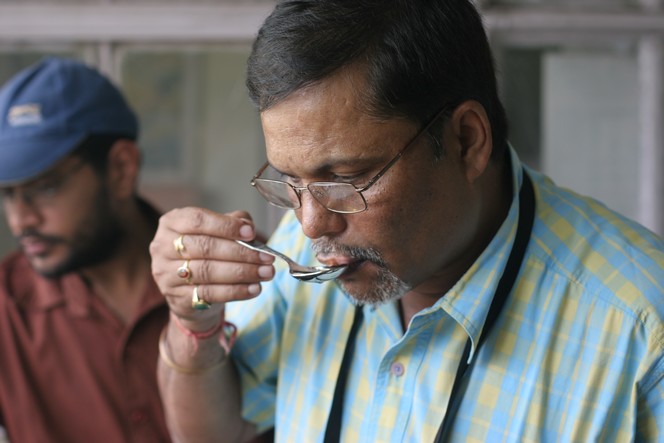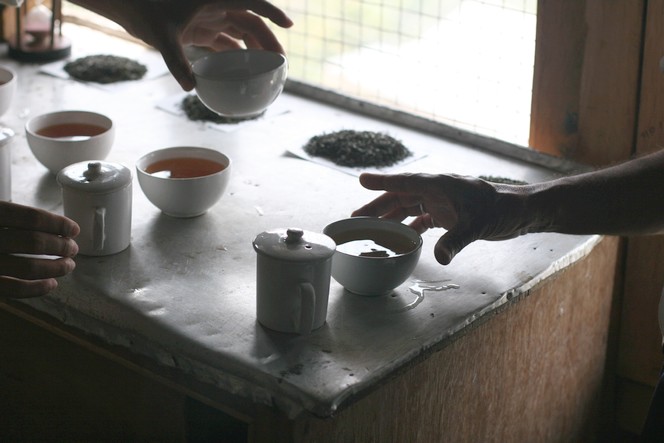
Tea tasting is a special moment for me. While we wait for the teas to infuse, we talk, or we look at the dry leaves. Then, when the tea is ready, we exchange cups, without a sound. We inhale the aromas of the leaves, look at the liquor, and taste it. Then we compare it with the cup beside it. It is a moment of pleasure and of concentration. Hand movements are precise and slow. To me, this serenity is important in order to appreciate all the pleasures offered by a cup of tea.
Pu Erh also requires wrapping with care
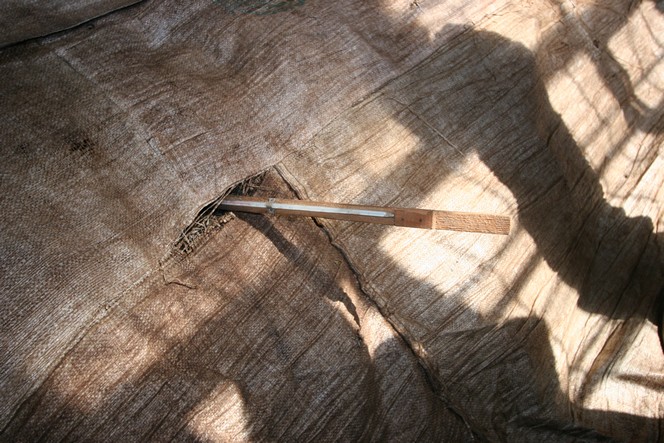
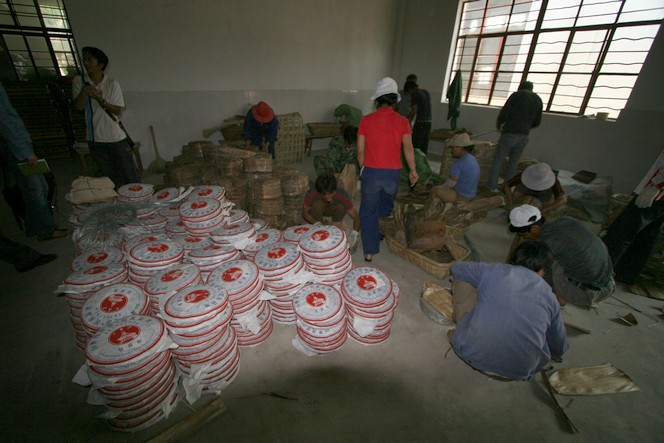
I know that your main objective at the moment is to wrap your purchases so they are ready to go under the Christmas tree in a few days’ time. Well, in China there’s a tea called Pu Erh which requires wrapping with just as much care. Pu erh can be bought loose, but it is mainly found in the form of a compressed cake. Having been left to dry on racks, each cake is wrapped in a sheet of printed rice paper, as you can see in this photo. The protected cakes are then wrapped in groups of seven in a dried banana leaf. The tea is then ready to embark on its journey and arrive with you after the festivities, which is just at the right time: in China, Pu Erh is said to lower cholesterol. Rightly or wrongly, it is sometimes known as the “fat-eating” tea.
Third flush Darjeeling teas are coming
A few days ago I bought a wonderful third flush Singbulli, and this morning I have just confirmed the purchase of a Rohini, also harvested in November. The first lot only weighs 70 kilos, the second lot just a little more, and they will arrive in France in December.
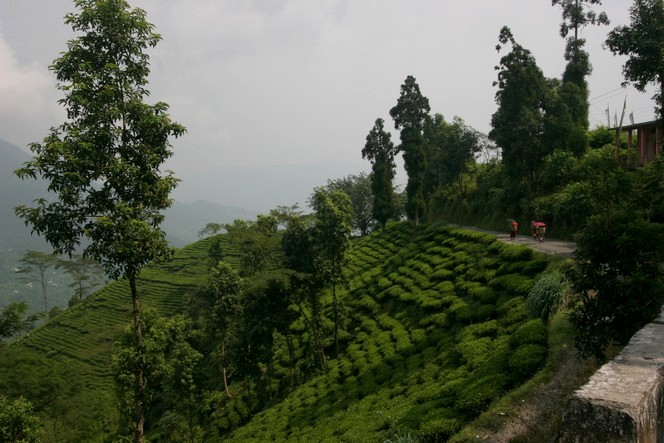
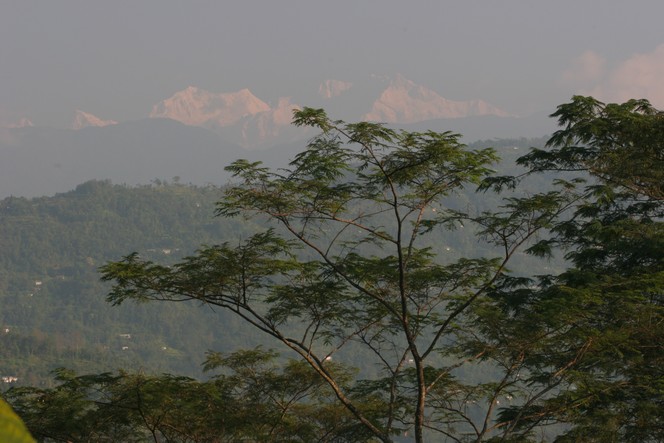
Those of you who love fine Indian teas must remember that Darjeelings produced in March, June and the autumn have very little in common. The reason is that this mountain you see here, Kanchenjunga (8,586 m), creates a great contrast with the weather conditions of the plains on the subcontinent. Darjeeling is one of the tea-producing regions with the most varied climate.
In warmer seasons, the southerly wind brings some of the stifling heat of the plains to these mountains. On the other hand, as winter approaches, the peaks make their presence felt, the sky becomes clear and the temperature drops. And the growth of the tea plants gets slower and slower, which is another reason for the variations in their flavours.
Snakes also live among tea plants
A few weeks ago I introduced you to a creature which, while not exactly loveable, is highly admirable. On my French blog, someone said it might belong to the Nephila family, others said it could be one of the Theridiidae or Nicodamidae families. After seeing the many comments you left, I’ve decided to introduce you to another creature today. Equally elegant, I encountered it recently after it slid silently between the branches of a tea bush, just level with my waist. Tea bushes are planted close to each other to make harvesting easier, which means that when you decide to venture into the middle of the field, your feet are completely hidden from view. So you walk looking straight ahead, moving as best you can. You don’t take any notice of the many beasts living in these humid conditions.
Here in Assam, while I was holding back the branches of the shrubs to clear my path, the man behind me stopped me suddenly because he’d seen something yellow near my left arm, undulating beneath the foliage. Once I’d got over my surprise, I turned my head slowly, moving as little as possible so that the animal would never imagine I was anything other than an ordinary tree trunk, to avoid stressing it unnecessarily.
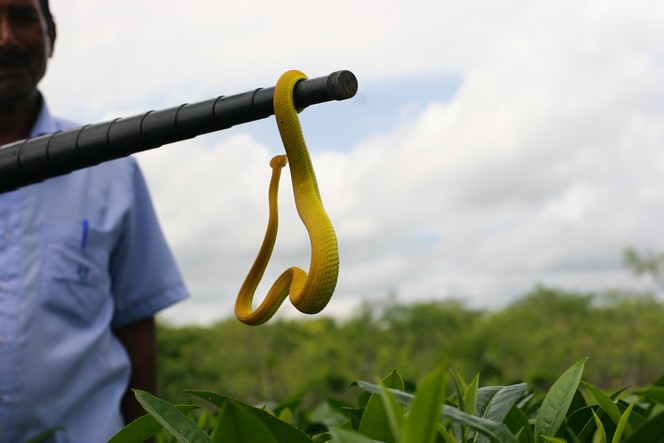
A few minutes later, my companion showed me this fine-looking snake on the end of his stick so that I could take its photo, and now I’d like to know its name. It was as beautiful as a rare jewel and as supple as a necklace, and it gleamed like gold. Before leaving us, overcome by shyness, the snake took the time to make something resembling a heart shape with its body, a way of asking us to respect all the love that nature offers us.
Length of infusion varies from one tea to another
Tea needs infusing for a specific length of time, and this can vary a great deal from one fine tea to another. A Japanese Gyokuro, for example, only needs infusing for a few seconds, while a white tea like Yin Zhen must steep for 10 minutes.
With some teas, like a Long Jing, for example, if you exceed the infusion time a little, it’s not a problem, and it won’t make much different to the final brew. However, if you leave a first flush Darjeeling for just a minute longer than you should, it’s quite simple: you’ll ruin it. It will become astringent and bitter.
So that’s why we need a timer when we prepare a good quality tea, and why we emphasise the importance of attention to detail with the infusion, to ensure you get the best from your tea.
In New York : my tea tasting lesson
I’ve just returned from New York, where I gave a tea tasting lesson to 35 journalists, bloggers and students from the prestigious French Culinary Institute. Cyrille and Aurélie Bessière, who moved to New York to foster a taste for fine teas among Americans, also took part in the exercise.
Having talked about the different colours of tea, and explained how to prepare them, we all tasted five different teas, taking time to consider their aromas, flavours and textures. Then, in the company of chef Mélanie Franks, who is well known for her use of tea in cooking, we set about tasting some interesting pairings of tea and cheese.
On the subject, I recommend you try a fresh goat’s cheese with a Dong Ding. You’ll find the creaminess of the former goes very well with the roundness of the latter. And if you want a different way of experiencing your Butterfly of Taiwan, serve it with an Ossau Iraty. A pure delight!
Citronella growing among organic tea plants
In some plantations where organic or sustainable farming methods are used, you will see citronella plants growing among the tea bushes or along the edges of paths. There are several advantages to the citronella’s presence, particularly its ability to repel many insects that would damage the precious tea leaves.
Pluckers checking the quality of their work
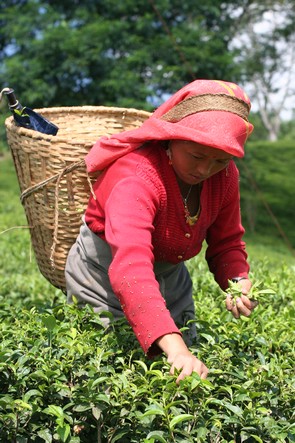
At the end of every morning and afternoon during the harvest, the women gather to get their leaves weighed. It’s an opportunity to relax, and everyone talks, unless they want to listen to what the others have to say. Of course, if they find a stranger like myself among them, as they did that day, their tongues wag even faster, accompanied by plenty of laughter.
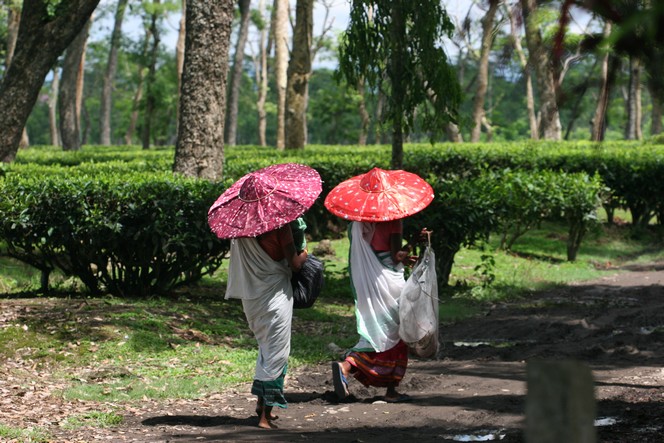
While listening to their colleagues joking, the pluckers run their hands through the leaves to check the quality of their work. The pretty red and white fabric these women wear on their heads is typical of their region: Assam.
Withering fills the leaves with a wonderful fragrance
The withering of tea leaves can take several tens of hours, during which time the leaves will lose some of their water content. In order to avoid the risk of oxidisation, hot or cold air is sometimes blown beneath the leaves. At this point, the air is filled with a wonderful fragrance, very typical and very floral, which can be detected for hundreds of metres around. I never grow tired of this smell. I find it captivating.
Elegant spider living among organic tea plants
With many plantations going organic, it is high time I introduced you to some of the nice animals that live among the tea plants, where the lack of pesticides makes for a quieter life. In terms of insects, for example, there are two categories: those that are detrimental to tea production, and those whose presence is beneficial. Among the harmful insects is the inchworm, which I talked about recently. There are many others. In terms of beneficial insects, the ladybird is one of the best known. Its rather comical appearance masks a ferocious predator that will destroy colonies of aphids with a remarkable efficiency.
As for spiders, some are harmful, while others can be useful. I don’t know which category this one falls into, but it is large and unusually elegant. I don’t even know its name, so if there are any spider lovers among you, perhaps you could introduce it to us.