From plant to cup

White tea withering

2 July 2010
White tea withering

White teas are one of the Fujian district’s (China) main specialties. The most well-known ones are named Bai Mu Dan (White Peony) and Yin Zhen (Silver Needles).
The manufacturing process of white tea is quite simple, as it can be summed up in two words: withering and firing.
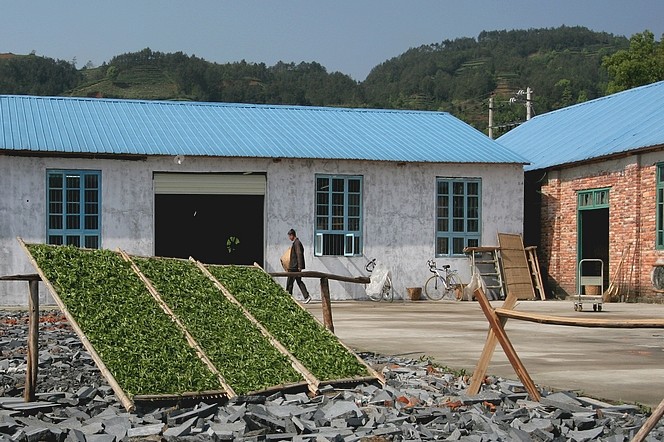
Traditionally, white tea is withered in the open air, just like here on these large bamboo pans which have been placed according to the course of the sun. This procedure will last from 48 to 60 hours. It is thus better to take the colour of the sun in consideration before plucking the leaves, in order for the harvest not to be ruined by the rain!

Share on Facebook. Tweet this!

Tea pluckers like wearing a cloth tube around their arm

25 June 2010
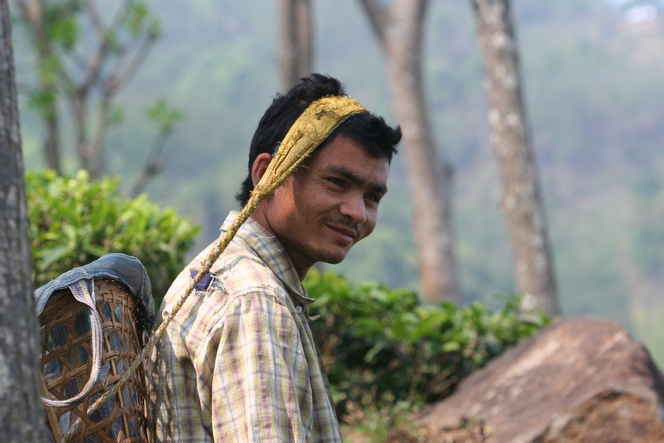
Tea pluckers like wearing a cloth tube around their arm

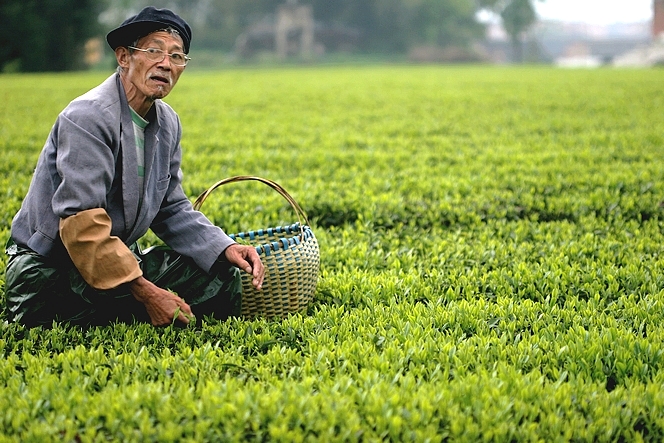
In different regions of the world, tea pluckers put on a wide cloth tube around their arm to protect their sleeve. A Camellia shrub proves to be quite tough and could easily widen a stitch of a fabric or simply tear a hole in it. This Chinese countryman I’m photographing unawares at work wouldn’t deny this.

Share on Facebook. Tweet this!

A tea tree’s natural inclination

22 June 2010
A tea tree’s natural inclination

Last Friday, I told you about a clever mechanical system developed to make tasks easier for tea pluckers working on steep grounds (see the article). But you may wonder why tea is cultivated on such abrupt fields. Let me tell you why: unlike rice, tea trees like  keeping their feet dry and can only be produced on a very well drained area. An inclined ground is therefore ideal for their growth, as the rainwater runs away. In flat tea plantations, farmers must then install a draining system to keep bushes healthy. It would be as well to make the most of a natural environment, much simpler and less expensive!

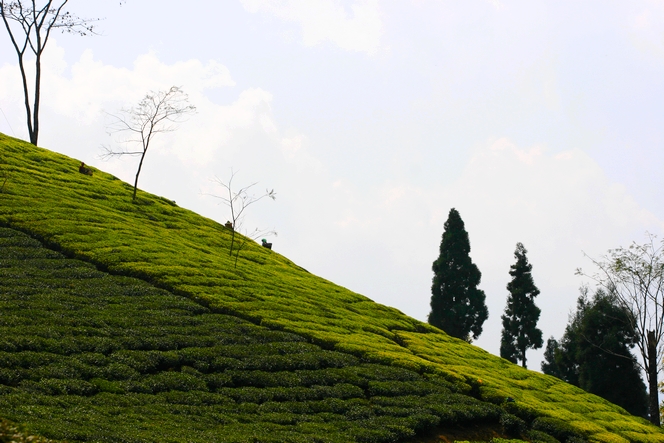
On this photo taken on the very steep Namring Tea Estate near the Himalayan mountains, notice the tea trees’ difference of colours. On the foreground, the harvest has already been done, whereas in the background, the light-coloured young shoots have not yet been plucked.

Share on Facebook. Tweet this!

A ski-tow for tea

18 June 2010
A ski-tow for tea

Tea can be difficult to transport when the ground slopes. I already talked to you about it a few weeks ago, I explained how the horse could be a precious help to transport tea in Nepal (see the article). For the men and women who work on the plantations, it can also be very difficult sometimes to haul up their baskets full of tea leaves. All the more so since the garden where the leaves are harvested and the building where they are then processed are not necessarily at the same height.

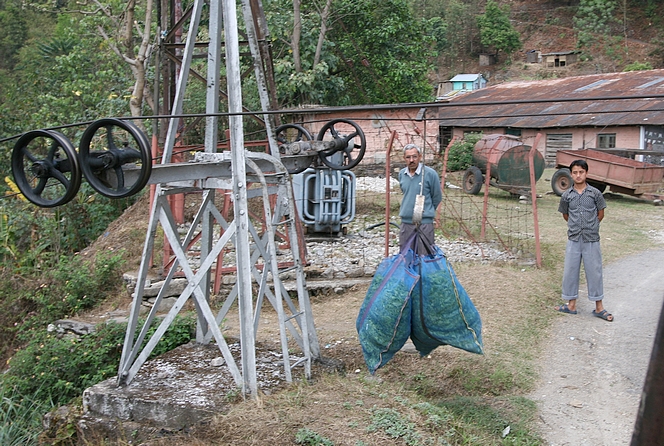
Some tea plantations have thus developed a mechanical system we could compare to a ski-tow, to transport the bags full of tea leaves. At Namring Tea Estates (India) for example, tea pluckers hang two or three bags at the end of a rope fixed onto a cable, which are then hauled up mechanically. A solution making tasks easier for men and gaining time as well.

In this photo, Mister Chaudhury and one of his assistants seem to be gazing at these sacks climbing unaided.

Share on Facebook. Tweet this!

Wu Long teas from Taiwan, jewels of teas

15 June 2010
Wu Long teas from Taiwan, jewels of teas

Wu Long teas from Taiwan are among the best teas in the world. By the way, we will receive beautiful Bao Zhong teas in a few days.

However, of that island, we easily have an image of a country whose activity is turned towards electronics and other micro-electronic components. In any case, not the image of an island whose territory is mainly covered by mountains. Taiwan is indeed divided by central ranges spreading from north to south and is very much appreciated by hiking lovers who enjoy walking on its small steep paths. During my trips, I can often see some of them, tired and out of breath but delighted by the beautiful landscapes around them.

This geography offering coolness and humidity combines the ideal conditions to grow high quality teas and we come across plantations a little bit everywhere in the country, each region producing distinct designations. The best Taiwanese teas are the “blue-green” or semi-oxidized: lightly oxidized Bao Zhong, Wu Long rolled up in perls (Jing Xuan, Gao Shan Cha) and Bai Hao Wu Longs.

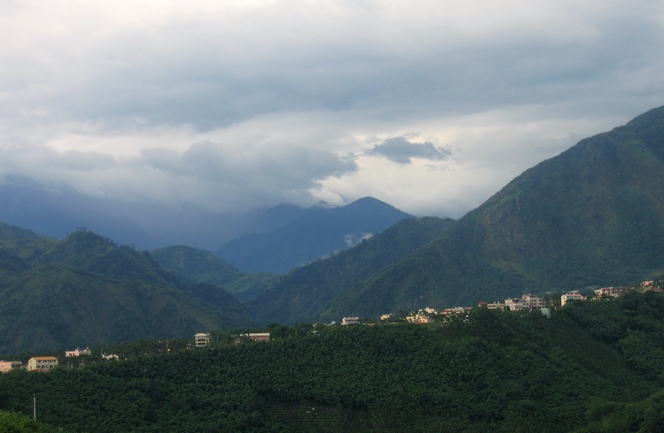
Carine (see the post My travelling companions of last Friday) took this photo when we were in the county of Nantou in the centre of Taiwan. You can see the village of Lu Gu, perched on the crest of the Shan Lin Xi mountains, not far from the lake with the same name and near the place where great Dong Ding teas are produced.

Share on Facebook. Tweet this!

In a tuk-tuk through the jungle of Sri Lanka

8 June 2010
In a tuk-tuk through the jungle of Sri Lanka

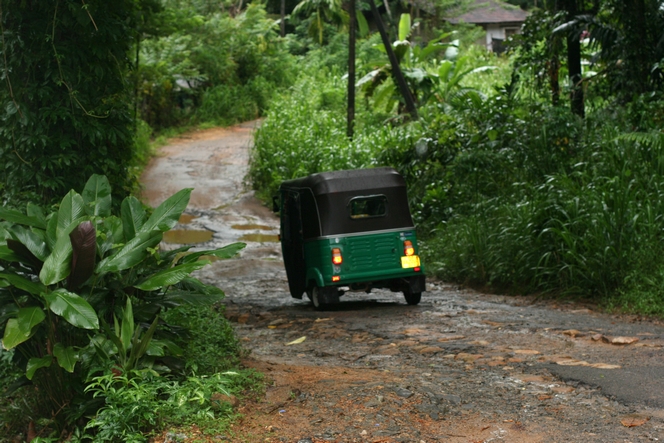
I don’t know which means of transportation you took to get to work this morning. As for me, I didn’t really feel like walking that day. It had just poured masses of water and I feared that it would start again. So in this jungle close to the forest reserve of Sinharâja in the South of Sri Lanka, nearby the plantations where you find the best FBOBEXSP teas (grade that defines the finest teas), I hailed a tuk-tuk. For several kilometers, I followed a small road and zigzagged between the puddles. The air was warm. Thanks to the smell of wet earth and ripe fruits, my trip to the Tea Factory become an amazing olfactory journey.

Share on Facebook. Tweet this!

China, birthplace of tea

1 June 2010
China, birthplace of tea

I have just acquired the first flush green teas from China for Le Palais des Thés.
China was the first country in the world to produce tea. It has been growing there for thousands of years. In comparison, India and Sri Lanka have only been producing tea for 170 and 140 years, respectively.

The legend about tea drinking goes back to Emperor Chen Nung, more than two thousand years ago. He had apparently stopped beneath a shrub to take a nap, a bowl of hot water beside him, as it was his custom. A gentle breeze then came up and removed from the shrub a leaf which dared to settle in the imperial bowl. We can imagine a host of devoted servants rushing forwards to change the dirty bowl, rinse it, dry it and refill it with nice clear, rippling water. But the Emperor, just from a sign of the hand, told his servants to stand back, and with a single index finger raised towards the sky, he said these few words:

“From what the Sky sends Us,
Is born harmony in Us.”

The Emperor then lifted the bowl to his lips. He tasted, he drank. He appreciated. He then asked what the name of the shrub was.

And so tea was born.

Share on Facebook. Tweet this!

Tea plucking by men in Nepal

28 May 2010
Tea plucking by men in Nepal

In some regions of the world, tea plucking is only done by women, while men are responsible for other jobs. It’s the case in India and central Sri Lanka, where men employed on the plantations tend the soil and prune the tea plants. Some people will tell you the reason for this is probably that women are more nimble-fingered and take better care of the fragile and precious leaves. 

But most of the time, like here in the north of Ilam Valley, eastern Nepal, opposite Darjeeling accross the border, the village men and women do the same tasks, including tea plucking. It is also the case in China and Taiwan. And in Japan, it is not rare to see a man carefully plucking the tea leaves and a woman behind the wheel of a tractor.

Is there really a reason for these practices? Well, let’s say that where the British used to be and where there are large tea plantations, the roles of men and women are different and the work is not always shared out in a way that seems fairest to us.

Share on Facebook. Tweet this!

Tea plants under canvas shaded from the sun

25 May 2010
Tea plants under canvas shaded from the sun

With the wonderful weather we’ve had in France over the past few days, we have to remember to protect ourselves from the sun.
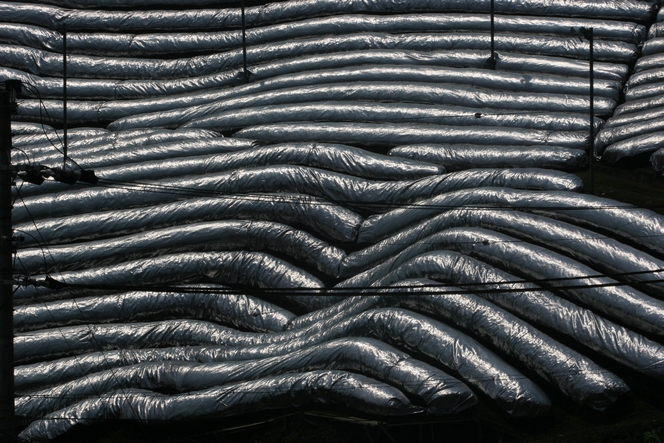
Did you know that tea plants also need protection sometimes? Actually, this only happens in Japan, where there are two categories of tea: “light teas” and “shade teas”. “Light teas” (Sencha, Bancha, Tamaryokucha) are harvested and processed from bushes explosed to sunlight, whereas “shade teas” (Gyokuro, Kabuse, Tencha) are made from tea plants growing in he shade, or even in darkness. As a consequence, the plants are under stress and react to it by by taking more nutrients from the soil. This unusual treatment gives a well developed, smooth and full flavour (which the Japanese call umami) without any bitterness. In other words, a delight.
 
I took this photo near Nara. I was attracted by these neat rows of tea plants covered with a silvery-black canvas, glimmering in the sun. I stopped to watch them, fascinated by their dark brightness, as you might stop in the moonlight to gaze up at the stars.

Share on Facebook. Tweet this!

Fans in the tea fields

21 May 2010
Fans in the tea fields

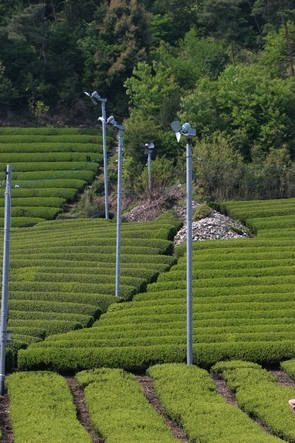
There are some curious sights in the tea fields of Japan. Multitudes of fans perched on top of posts ruffle the rows of green foliage, their metallic appearance contrasting with the soft shapes of spring. What are they for? To create a breeze when the sun gets too hot? Not at all! In fact, the fans are used in the depths of winter, when they are switched on to stir up the air and prevent layers of cold air stagnating above the tea plants. This cold layer could damage the shrubs, or slow down their growth.

Share on Facebook. Tweet this!