The Lisus climb giant tea plants

23 November 2010
The Lisus climb giant tea plants

Many ethnic groups live alongside one another in the province of Yunnan (China). The Hans are there of course, as is the case across China, but at least 20 minority groups live there too, including the Dais, Miaos, Nus, Huis, Was and Yis. Here, on the border between China and Myanmar (Burma), we are with the Lisus.

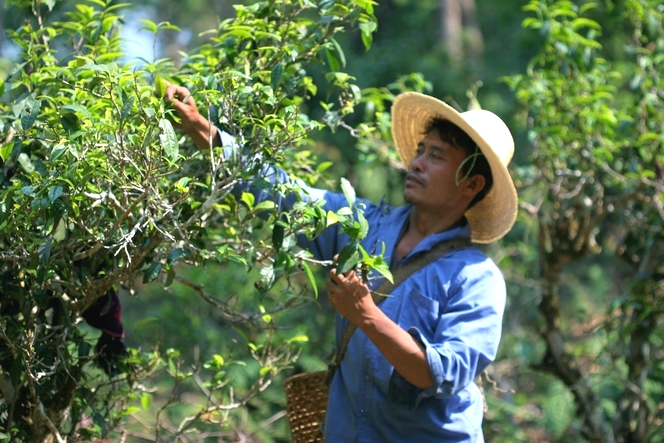
These people live from farming in the remote mountainous regions. They also grow tea, or rather, they harvest the leaves that grow on giant tea plants. It is an incredible sight to see them in their traditional costumes climbing to the tops of trees 10 or 20 metres high, wicker baskets on their backs, working away. It makes you hold your breath.

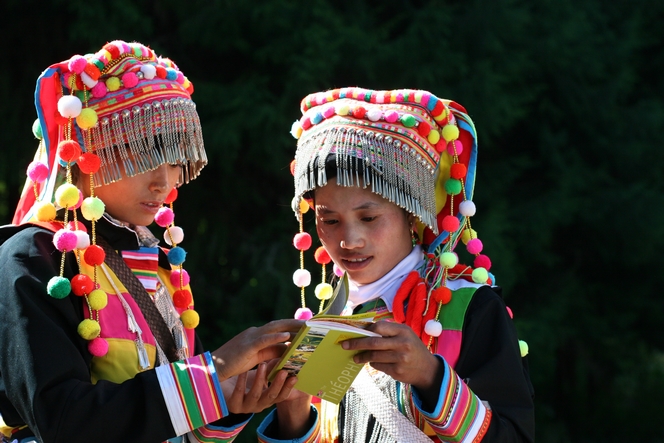
Here, I have caught two Lisus women closely examining the Théophile Guide. They are looking at the list of stores on the back cover with quite serious expressions that contrast with the strings of brightly coloured fluffy balls that swing gently on either side of their faces.

Share on Facebook. Tweet this!

The long road to the Pu Er plantations

19 November 2010
The long road to the Pu Er plantations

The Pu Er plantations are not an easy place to visit, but they are worth it. The tea leaves used to make Pu Er grow in the remote regions of Yunnan, mainly in Simao, Lincang, Xishuangbanna and near Da Hong. It was Da Hong I visited this month, an experience I shall never forget. Da Hong is an hour’s flight from Kunming, which is nothing, but you then need to drive for at least eight hours to see the famous tea plants. At first you drive along a motorway under construction, so all you see is the golden dust thrown up by the vehicle in front. Visibility is reduced to just a few metres, and what’s more, you have to swerve around all the potholes. These testing conditions last for a good 100 kilometres, and you must hurry as the road closes at a set time to let the bulldozers in. If you arrive at the barricade too late, you have to do a U-turn and try again the next day. But if you get past all these obstacles in one piece, a magical landscape awaits you the other end. With the altitude, the air cools, and the stunning mountain drive makes you forget what came before. The vegetation changes, conifers appear, and then you come out onto the magnificent high plateaux.

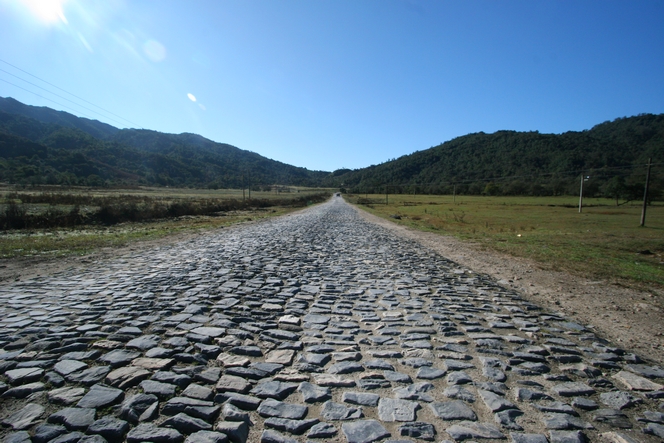
Buffalo and horses roam free, and donkeys cross the pretty paved road whenever they feel like it. It gives you an overwhelming sense of freedom. It is time to take a break. It is a long road to Pu Er. The day has been exhausting, so we walk a little, filling our lungs with the pure air we lacked during the day, and allowing our gaze to wander to the distant horizon. Tomorrow we will be back on the road and cross a few more mountains to reach Su Dian, a few dozen kilometres from Myanmar. There, waiting for us, are people who are little known outside their region.

Share on Facebook. Tweet this!

Semi-wild tea plants in Yunnan

16 November 2010
Semi-wild tea plants in Yunnan

The harvesting of leaves used to make Pu Er is interesting. Here, in the west of Yunnan near the border with Myanmar, the tea plants are left in a semi-wild state, and the plucking consists of a walk through the forest. Instead of keeping the tea plants cropped at a convenient height for harvesting, as is usually the case, they are left to grow into trees, or always have been, and the workers walk around them to pluck the bud and the next two leaves, as is the practice with all other teas.

Share on Facebook. Tweet this!

Rows of perfectly aligned tea plants in Japan

12 November 2010
Rows of perfectly aligned tea plants in Japan

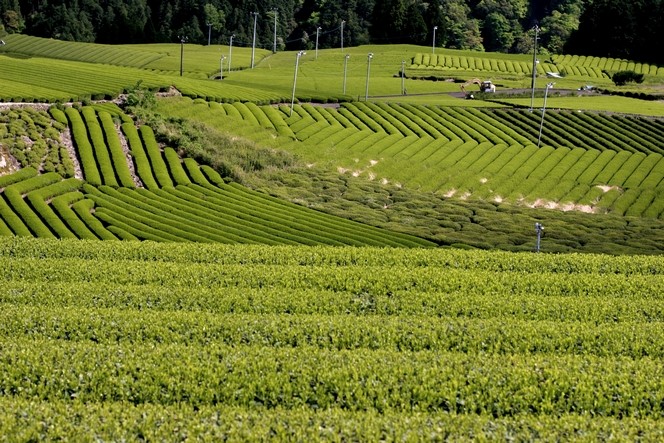
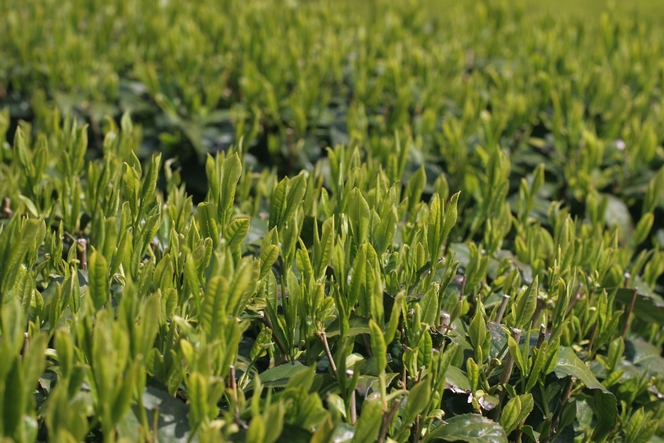
Just before leaving Japan for China, here is a last glimpse of the landscape shaped by tea. Here, the rows of tea plants are precisely aligned. All is in perfect order, with a few organised clumps here and there, as if to underline the overall harmony. What I love most are the subtle nuances of green, the different shades of the same colour, a touch more yellow where the shoots are still young, slightly darker green where the leaves have recently been plucked.

Share on Facebook. Tweet this!

Yabukita: the most popular cultivar in Japan

9 November 2010
Yabukita: the most popular cultivar in Japan

While all tea plants belong to the camellia family, you know that there are different cultivars within that family. Here in Japan, the tea plant most commonly grown is Yabukita. It accounts for 85% of the tea crop, unlike in other tea producing countries, where many different varieties cohabit.

Yabukita is easy to recognise with its long, straight, intense green leaf. It also has its own way of growing, very straight, reaching up for the sky.

Share on Facebook. Tweet this!

In Ryogôchi: high quality Gyokuro and Sencha teas

5 November 2010
In Ryogôchi: high quality Gyokuro and Sencha teas

A typhoon has just swept through Japan, from the south to the north. I don’t know what delayed it, because it was very late; typhoons normally hit Japan in September. Violent winds flip your umbrella inside out and rain drenches you from head to toe.

It seems I didn’t choose the best day to visit Ryogôchi and admire these mountains, where some very high quality Gyokuro and Sencha teas are grown. However, this abundance of clouds does add to the mystery of the place. Although the village itself is slightly hidden, along with the river Okitsugawa, you can still make out some shapes, and it is very Japanese to suggest, rather than to assert.

Share on Facebook. Tweet this!

Kyoto: a city where time stands still

2 November 2010
Kyoto: a city where time stands still

I am writing this in the city where time stands still, where thousands of temples are hidden, where the gardens are of moss or of stone, but always invite contemplation. Here, everything is silent, beautiful, refined.

Those on a journey of self-discovery can loose themselves among the narrow paved streets. Will you see reflected in the surface of the stream the geisha about to cross the bridge, her face whitened with rice powder and protected from the sun by a delicate parasol? Will you hear the clicking of her pretty wooden clogs? They echo to the beating of a heart: perhaps mine, perhaps yours. This is Kyoto.

Share on Facebook. Tweet this!

In Japan, some teas are deprived of light

29 October 2010
In Japan, some teas are deprived of light

In Japan, there are teas grown in the light, and teas grown in the shade. These shaded teas, which are called “Kabusecha” here, are deprived of light for three weeks before harvest. This inhibits the process of photosynthesis in the leaves, meaning the tea plant must draw heavily on its own store of nutrients. This changes the chemical composition of the leaves as well as the aromatic properties.

In terms of flavour, it makes the tea smoother and more delicate, and it develops less bitterness. The best known “Kabusecha” tea is called Gyokuro, which has distinctive dark green, fine, glossy leaves.

In this photo I took very near Shizuoka, you can see how some of the tea plants have been covered by a large tarpaulin to shade them from the light.

Share on Facebook. Tweet this!

In Shizuoka, a festival is dedicated to green tea

26 October 2010
In Shizuoka, a festival is dedicated to green tea

As you read this, I will be arriving in the Land of the Rising Sun. I am here because every three years, a celebration of green tea is held in the Shizuoka region: the O’Cha Festival. It is an opportunity to meet many farmers who grow tea in the surrounding mountains and who leave their tea plants to come and meet other growers, customers and journalists. At the festival, you can try many teas, or watch a matcha tea being made, or a temomi cha, the tea that is entirely processed by hand.

Drinking green tea, whether a superior quality or an everyday brew, is part of Japanese culture. The Japanese serve green tea throughout the day and even drink it while walking in the street, getting it from the numerous vending machines you see everywhere in the country. The Japanese ceremony of Cha no Yu is deeply rooted in tradition, going back more than 500 years, like the Ikebana art of flower arranging, for example.

At the O’Cha Festival, you can taste some very special teas. Several competitions are held during the fair to select the best green teas of the year.

The farmers are immensely proud of the recognition this brings their tea. Here is one family in the middle of harvesting a sencha. Their plot is not big, but their tea is worth its weight in gold.

Share on Facebook. Tweet this!

In Darjeeling, a separate state is subject of debate

22 October 2010
In Darjeeling, a separate state is subject of debate

There has been political tension in Darjeeling for some 30 years. While everyone agrees on remaining within the Indian Union, a large proportion of the population would like some independence, with their own Indian state, instead of being part of West Bengal as the region is today.  Being a separate state, like neighbouring Sikkim, might result in better infrastructures, with direct funding from the capital Delhi instead of having to wait for aid that never comes from Kolkata. Most people in Darjeeling are Indians of Nepalese origin who would prefer to be able to make their own decisions on matters that concern them. Some have already given the future state a name which you see scrawled along the roadsides, and which is being chanted by these protesters marching in Darjeeling: “We want Gorkhaland!” You can see they are waving two different flags: the flag of the future Gorkhaland, and the flag of India, to show that they want the new state to be firmly embedded within the Indian Union.

Share on Facebook. Tweet this!