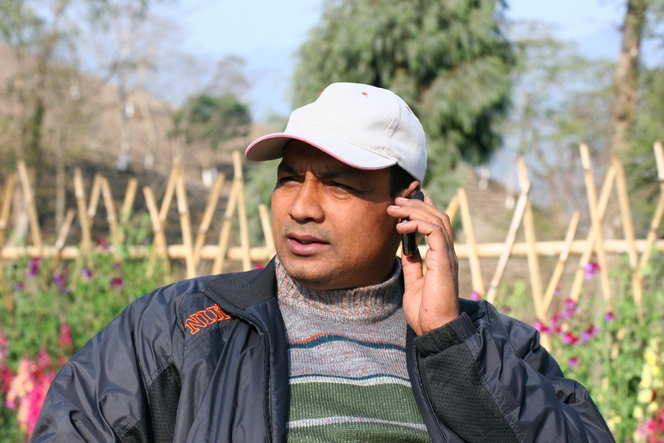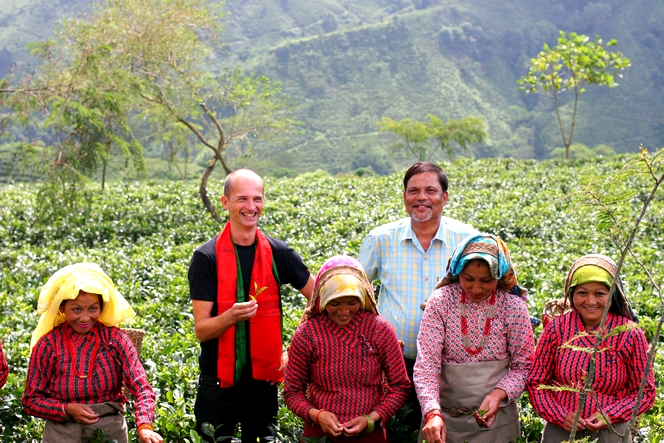
Last week I had the pleasure of visiting the Balasun plantation, in Darjeeling. The plantation got its name from the river Balasun, which runs below it. Anil Jha, who manages the Sungma Tea Estate, and who you can see beside me in this photo, also supervises the Risheehat Tea Estate and the Balasun Tea Estate. He is one of the most respected and most experienced growers in Darjeeling. There are only three or four others with his level of expertise – and authority. I admire him, and I’m also grateful to him, because he was the first person to teach me so much, here on these mountains. We first met 20 years ago, so he has seen me progress, professionally speaking.
Whenever we meet, we talk for hours, united by the same passion.
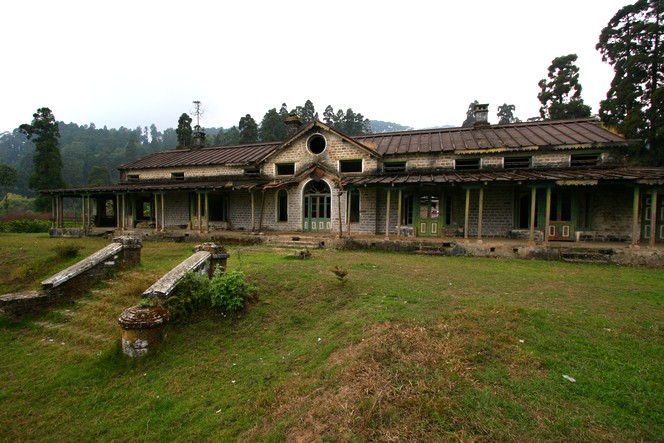
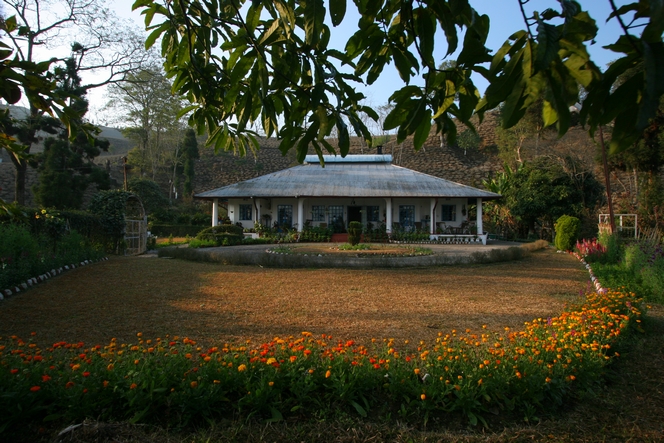
Tea grower’s bungalow in Teesta Valley
This is the type of house I stay in when I’m in Darjeeling. It is a grower’s bungalow, and is typical of the region. There is one on each tea plantation, where the grower and his family live. I took this photo last week. When I woke, I sipped my early morning tea, served in bed as is the tradition, and waited for the sun’s rays to warm up the ground and flood the flower beds with light.
Darjeeling : tea trade is threatened
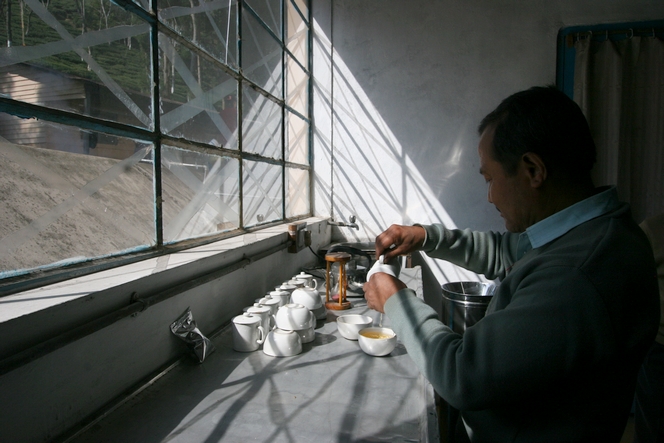
The situation in Darjeeling has improved considerably. The road blocks have been lifted, the shops have reopened and life is getting back to normal. But the tea trade is still affected, as the party campaigning for independence is threatening to prevent the movement of trucks carrying the tea in a few weeks’ time, in order to demonstrate its political clout and bring negotiations to a conclusion.
However, this does not stop me from enjoying a quiet moment tasting teas, as I am about to do here at the Teesta Valley Tea Estate factory.
In Darjeeling, I have had to change my plans
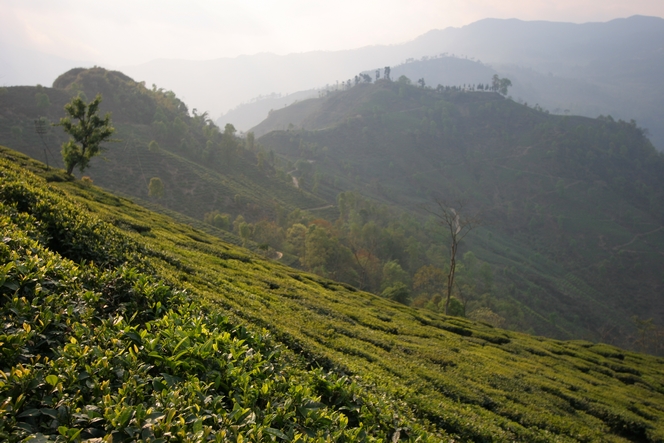
Because of the heightened unrest in Darjeeling this year, I have had to alter my plans. The movement in favour of the region’s independence will decide today whether or not to block all the roads and shut down the shops again. So instead of visiting the Balasun plantation in the Kurseong region, I have decided to take a detour east. My friend Abhishek Dev, the grower at the Teesta Valley Tea Estate, came to collect me a short while ago from Bagdogra airport, and took me to his bungalow. Teesta Valley Tea Estate is in the extreme east of Darjeeling and from here, I can decide whether to go to Darjeeling city or not, depending on the turn of events tomorrow. At least, thanks to Abhishek, I have the latest news from Darjeeling and on the forthcoming harvest. And this evening, I can also meet the growers from Gielle, Runglee Rungliot and maybe Namring. These four tea plantations, situated at quite a distance from Darjeeling city but, of course, within the prestigious “appellation”, are some of the most beautiful in the region. In this photo you can see the view I have from here, in the late afternoon, walking towards the Gielle Tea Estate.
Calcutta : a place I really love
The City of Joy is also the city of tea. All the tea produced in Assam and Darjeeling is shipped from the port of Kolkata (also known as Calcutta), and the plantations in the north of India all have offices in the city. So I often come here, and go to tea tasting after tea tasting.
The city is unbelievably dilapidated. It is overpopulated, overcrowded, crumbling, stifling, humid and disgustingly dirty. It has a way of sucking the life out of you. Yet despite all this, I really love the place. I am happy in Kolkata.
Le Palais des Thés team in Tomsong
This morning I left for Kolkata. From there I will travel to Darjeeling, probably on Tuesday. The spring harvest will begin soon, and it is time to visit a few plantations, find out more about the crop, and “test the temperature” of the region in more ways than one. Tea plants go to sleep in the winter, because of the cold, and wake up again when the air warms up. Inversely, the people get fired up during the winter months over the issue of independence, and cool down in the spring when the tea and tourist trades pick up again.
There is an important stage in tea processing that I am sorry not to be able to share with you: the “withering”. This involves blowing air – preferably cold – over the leaves, which give off an incredible fragrance like white flowers, lily and jasmine. In this photo taken in Tomsong in October 2010, during a trip with the team, everyone is cupping leaves in their hands and inhaling the wonderful aroma.
If you would like to see some other highlights from our trip, click on this link (in French):
http://www.palaisdesthes.com/fr/le-the/palais-des-thes-darjeeling.htm
Matcha is crushed in a stone mill
In Japan, a special tea is served during the Cha No Yu, the famous tea ceremony. It is called Matcha.
Matcha differs in appearance from other Japanese teas in that it is ground into a powder. In any other tea-producing country, tea that comes in broken leaf or dust form would be a sign of poor quality, but in Japan, Matcha is one of the most renowned teas due to its high quality. It comes from a shade-grown variety of plant called Tencha. The tea leaves are ground in a stone mill which is filled from the top. The result is this very fine powder which, as you can see from my photo, collects around the edge of the two stones that rotate across each other and push the tea to the outside.
Hattori Koji-San, a master potter in central Kyoto
In my previous post I spoke of the master potter Hattori Koji-San. I showed you his agile hands at work. Here he is in his studio in the centre of Kyoto. For the photo, he decided to sit where he would normally place his wheel. This year, Le Palais des Thés has asked Hattori Koji-San to make its raku bowls. The various colours are achieved by the use of different mineral pigments. Part of the craftsman’s skill is to achieve the desired crackled finish to the glaze, along with the black, red or white tones that can symbolise stars or seasons, snow or night.
Raku : a technique used to make tea bowls
Each tea accessory used during the Cha no Yu (the Japanese tea ceremony) is made using the methods of an ancient craft. Raku is a classic technique often used to make the “chawan”, the bowl used in the tea ceremony. This process involves firing at a very low temperature.
Here, in the Kyoto studio of Hattori Koji-San, I watched the master potter deftly work the clay and gradually shape the contours of a tea bowl.
In each country, people prepare tea differently
In Japan, they have the Cha No Yu, or “way of tea”; in Russia they prepare their brew in the samovar. The British have their tea time, the Indians drink chai. And when the Chinese prepare fine teas, such as rare Wu Longs, or Pu Ers, they follow the rules of the Gong Fu Cha.
Gong Fu describes an activity that is carried out slowly, with great self control.