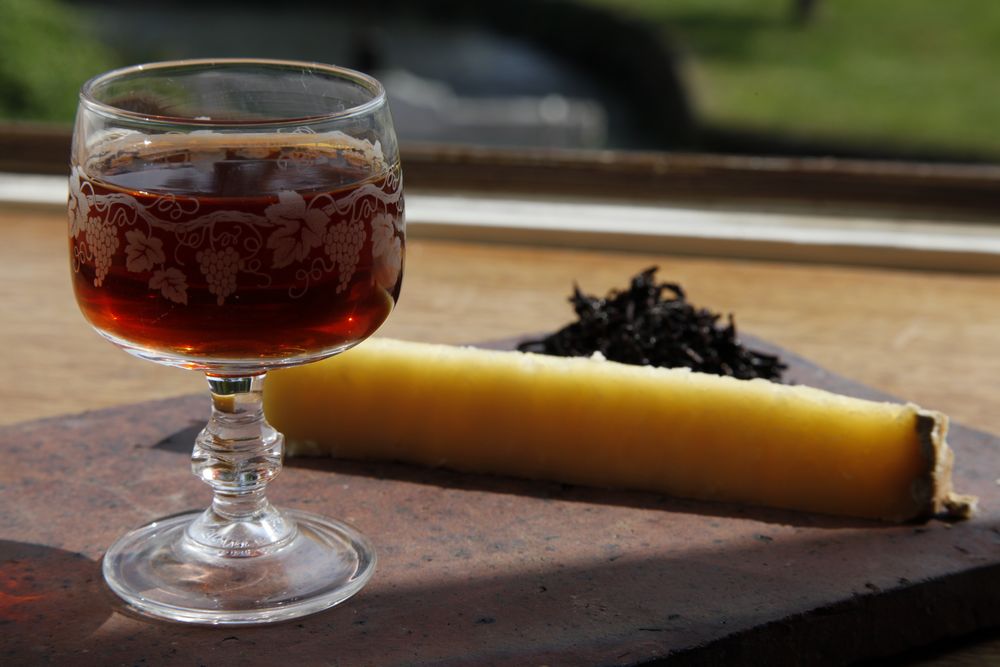
If you love cheese it can be good to have a change. Rather than drinking wine with cheese, how about trying it with tea? Combinations of cheese and tea arouse curiosity, and this week I’m suggesting a new pairing: Thé du Tigre and Roquefort. I’m not a big drinker of smoked tea but it has to be said that with a blue cheese as strong as this, the combination works very well. The warmth of the tea quickly melts the cheese in the mouth, and the woody, animal, smoky and milky notes mingle and complement one another. Try this sensual, creamy pairing and see what you think.
Tea and food
A meeting with Daniel Rebert, pastry chef
There is nothing I enjoy more than thinking about what tea I will drink next. For me, the pleasure of tea begins as soon as I lift the lids from my canisters, inhale the scent of the leaves and decide which one is best suited to the moment, mood and season.
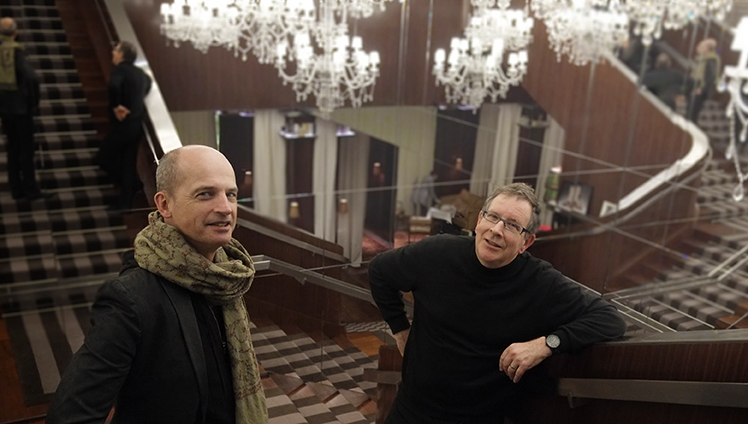
From time to time, this exercise moves beyond the close confines of the teapot, when considering which tea will go best with a particular food. A few days ago, the journalist Laura Annaert arranged a meeting between the well-known pâtissier Daniel Rebert and myself at the Royal Monceau Hotel in Paris. She wanted to listen to us both as we decided on suitable pairings between Daniel’s creations and my selection of fine teas. Together, we tasted a Butterfly of Taiwan, a Qimen Imperial and a Shiraore Kuki Hojicha at different temperatures. We compared the textures, the toasted and toothsome notes, and the aromas of leather, cocoa and wood, while enjoying delicious millefeuilles, biscuits and chocolates. It was a very fruitful discussion!
(photo: Victoire Avril)
Tea and food pairing: Cantal Vieux and Bourgeon de Pu Er
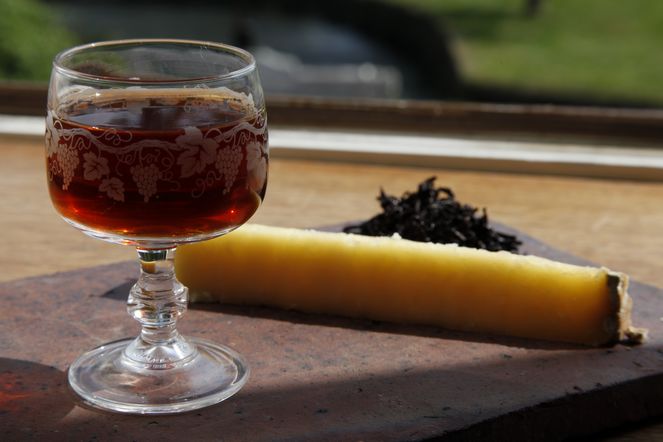
I’ve already written about cheese, when I celebrated the pairing of a fresh goat’s cheese and a Premium Bao Zhong. Today I’m recommending another combination: a Cantal Vieux and a Bourgeon de Pu Er. The tea is infused hot, as usual, but it’s best to then let it cool and drink it at room temperature. This allows you to prepare your tea a few hours before the meal, keeping it in your teapot. To serve, I suggest a small clear carafe and liqueur glasses. Your guests will be amazed! I’m sure they’ll appreciate the richness of this accord, the balance and harmony between the woody, undergrowth and animal notes of the Pu Er and the notes of the Cantal Vieux.
Pairing tea and cheese: the example of goat’s cheese
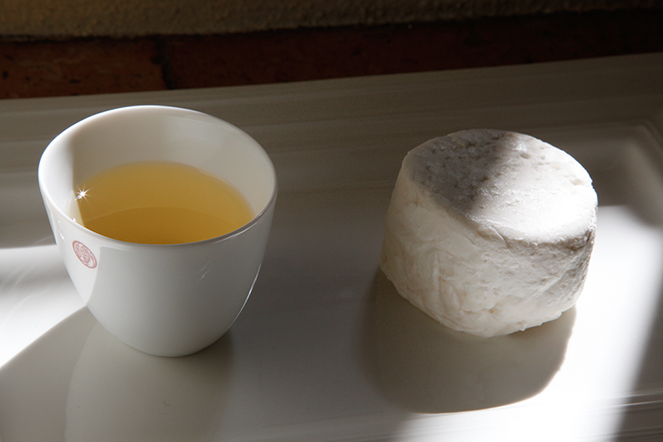
Pairing tea and cheese: the example of goat’s cheese Fresh goat’s cheese is one of my favourite cheeses, and I like going to the farm to choose mine. I prefer to accompany it with tea rather than wine. More precisely, a Premium Bao Zhong served at room temperature. To prepare it, first steep the tea for six minutes, then remove the leaves from the pot and leave it to cool for 30 minutes. Serve in small clear liqueur glasses. It will make an interesting change for your guests, and you will love the pairing: the tea does not overwhelm the subtle flavour of the cheese; on the contrary, it accompanies it, as the tea’s vegetal and floral notes make way for the milky, delicate animal qualities of the cheese. They make a fine match.
Knowing how to appreciate bitterness
Bitterness is the only intelligent flavour, Olivier Roellinger told me as we tasted a selection of teas together, when I warned him that some darjeelings have a touch of bitterness.
It is a flavour that, unlike sweetness, needs winning over, taming. It can be off-putting, but when we know how to appreciate bitterness, it offers such richness, such delight!
And Olivier Roellinger talked to me about the famous Italian gastronomy, a fine example of a bitter cuisine.
Two “grand cru” teas from Nepal to try soon: Mist Valley and Sandakphu
Three plantations in Nepal are currently producing teas that in my view are worthy of the “grand cru” appellation. But in the past year, it has to be said that Guranse, Kuwapani and Jun Chiyabari are no longer alone in offering exceptional teas. Mist Valley and Sandakphu, both situated in Ilam Valley, are making teas of remarkable flavour quality. These teas will be ready to try in a few days, and are excellent value for money.
Making tea requires great precision
Olfactory journey for the Césars
At the end of February I was invited to lead a tasting session for some actors, most of whom had been nominated for a César award. Throughout the day, they arrived at a suite in a Paris hotel. Among them was also Kevin Rolland, Olympic Gold medallist at Sotchi (see photo), as well as television presenters and journalists. I enjoyed introducing them to some Grand Cru teas such as Dong Ding, Tawaramine, Dan Cong and Jukro. And I surprised them with Pu Erh. Many of them really appreciated this astonishing tea. They stuck their nose into the infused leaves, which reminded some of a walk through the forest, others of a stay on a farm. An olfactory journey.
Tasting third-flush Darjeelings
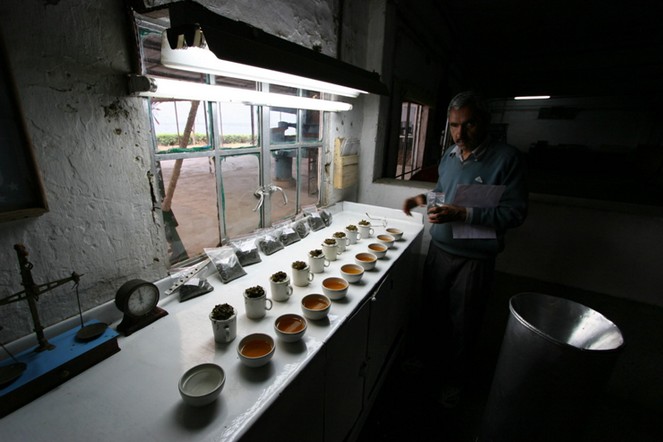
Scales, a timer, a spittoon, a cup to rinse one’s mouth between two liquors if necessary, a shaft of light; everything is ready. Admittedly the building itself is showing signs of wear and tear, but that’s not important; Namring teas retain their incredible aura and I’m about to taste the best of the third-flush, or autumn, pluckings.
There’s a tea for everyone
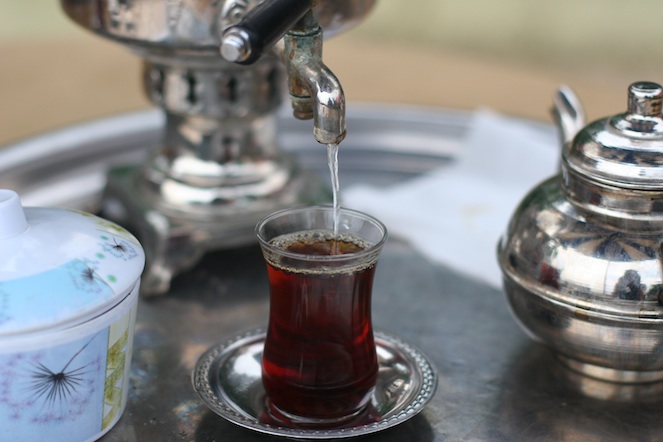
There’s a tea for everyone. Our Turkish friends drink it boiling hot, at any time of day or night, generally out rather than at home. You start by pouring a little tea extract, which is particularly strong, into the glass. Then you dilute it with hot water from the samovar. And you pass the time talking about this and that, glass of tea in hand. Or you watch a football match in the local café, either holding your glass of tea or placing it on the table in front of you.