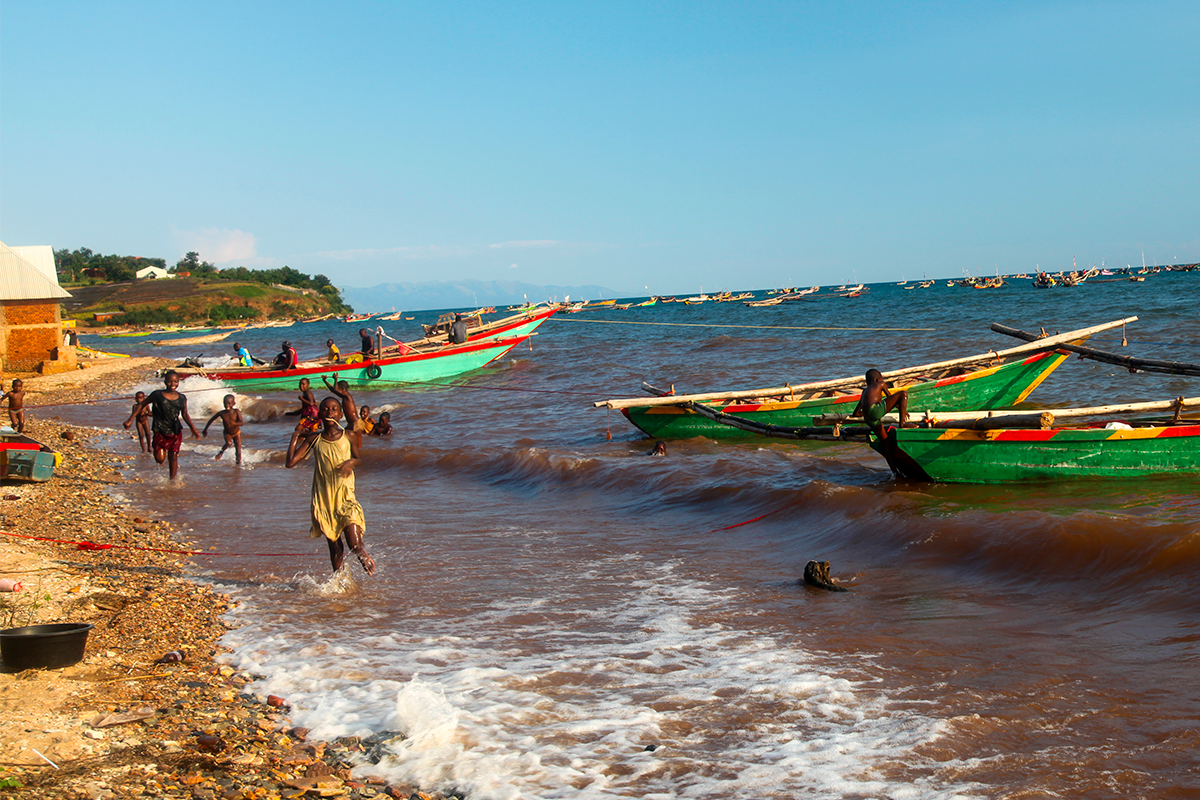
Several East African countries are among the world’s biggest tea producers. In Burundi, I travelled along the shores of Lake Tanganyika to the Tanzanian border, gazing across the water towards the mountains of the DRC (Democratic Republic of the Congo), while at night, the fishing boats scattered across the lake glittered like a constellation of stars. In a week, I did not come across a single Westerner, and some local children had never seen one, rushing over as soon as they caught sight of me. They emerged from the water in a constant stream, full of excitement, laughter and curiosity. I barely had time to snap a few photos and try to answer their eager questions before returning to my vehicle, leaving them to their waves. After hours on chaotic tracks that tossed me violently in every direction, I headed for the mountains. In Burundi, those long hours spent being jolted along gruelling roads have a name: the African massage.
On my return to France, someone pointed out to me that my photo wasn’t straight, that the lake was tilted. At the time, I didn’t believe them. Nor did I later. I had never seen anything like it. I want to believe my photo is faithful to what I was lucky enough to witness. I want to believe it is faithful to that unexpected axis on which beautiful Lake Tanganyika seemed to rest. When you travel, you have to accept being challenged, to confront other ways of seeing the world. That is all part of the charm of adventure. Here is the lake as I saw it that day: tilting gently to the left, no doubt beneath the weight of the boats and the children’s laughter.