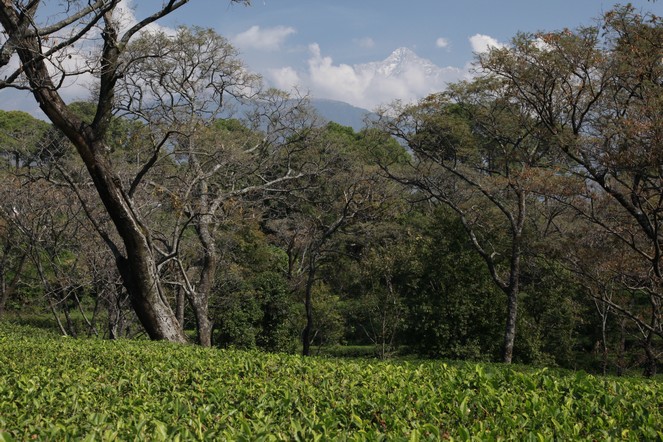
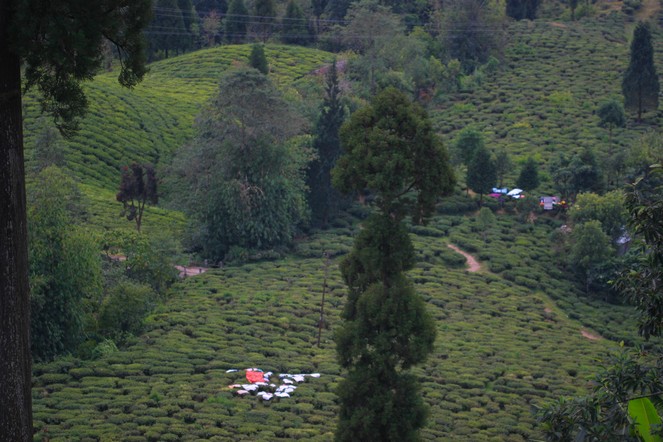
I don’t know how you usually dry your laundry. If you have a beautiful landscape in front of your house, like here, with tea plants on your doorstep, the bushes make an excellent structure on which to hang out your clothes. This method is adopted on many plantations.
It just goes to show how many uses there are for the tea plant.
From plant to cup
The last autumn teas in Darjeeling
In a month’s time, the Darjeeling season will be over.
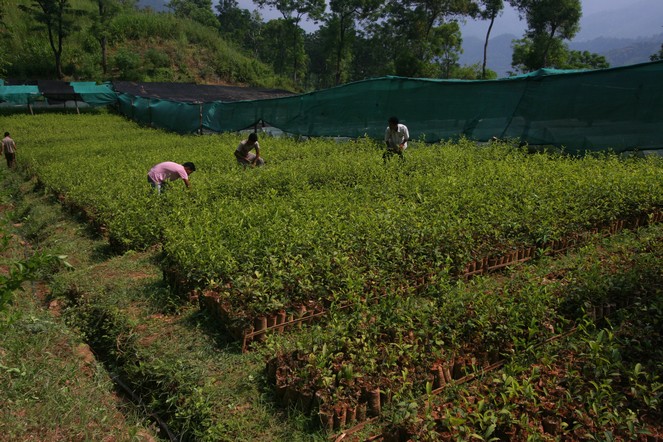
The temperature will drop and the tea plants will go dormant. Before then, a few autumn or “third flush” teas are still being produced, and there are other jobs to be getting on with, like here, at Delmas Bari, where the young shrubs are being tended to.
These ones are now big enough to leave the nursery and be planted out in the ground.
Century-old wild tea plants
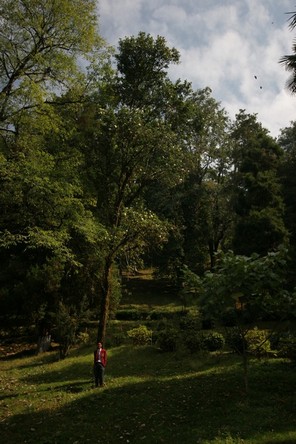
You may have to drive for several days to see them. But you will also find a tea plant the size of a tree in Darjeeling, in the Botanic Gardens. It is the same age as the region’s tea plantations, nearly two hundred years old.
To give you an idea of its size, I asked someone measuring around 180cm to stand at its foot.
Expertise makes good tea
Because I visit the production regions regularly I am able to stay abreast of changes that take place on the plantations.
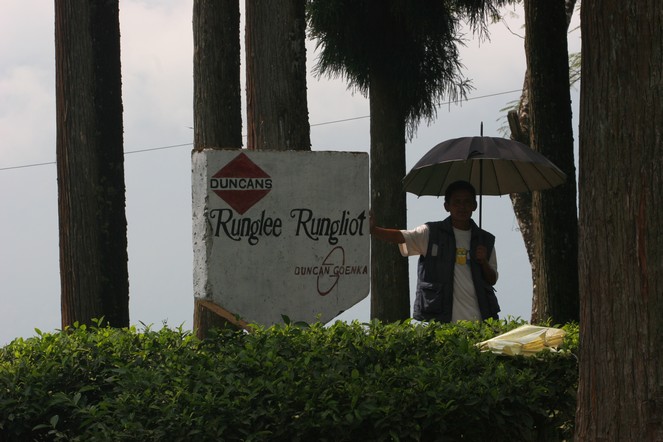
I’ll give you an example: today, a garden like Runglee Rungliot is completely unknown among the public, and justifiably so – it does not produce good tea.
But for things to change radically, all it needs is an experienced planter to come and work at the garden. The tea plants, the altitude, the orientation: this place has it all, and one day it will produce top quality teas.
India: heavy rains cause landslides
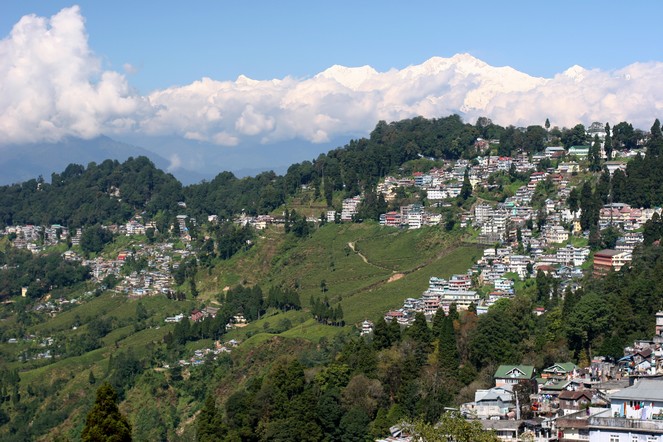
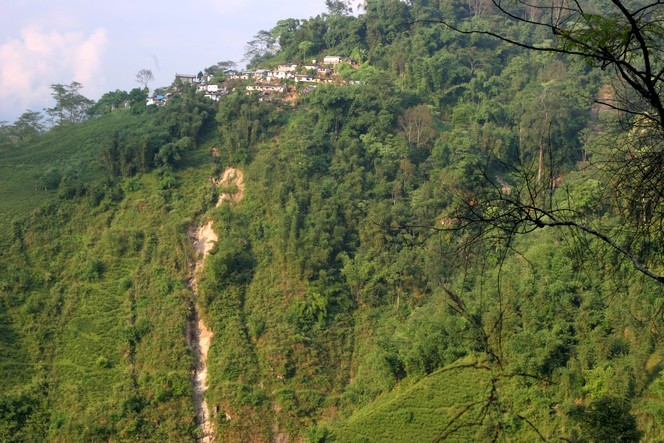
During the months of July and August there are heavy rains in Darjeeling, and many landslides occur in the weeks following the downpours. Sometimes you see a pretty little village that appears to be suspended over a ravine.
The tea plants you see in the foreground and on the slope itself are near Lingia.
Plucking tea from full-sized tea plants
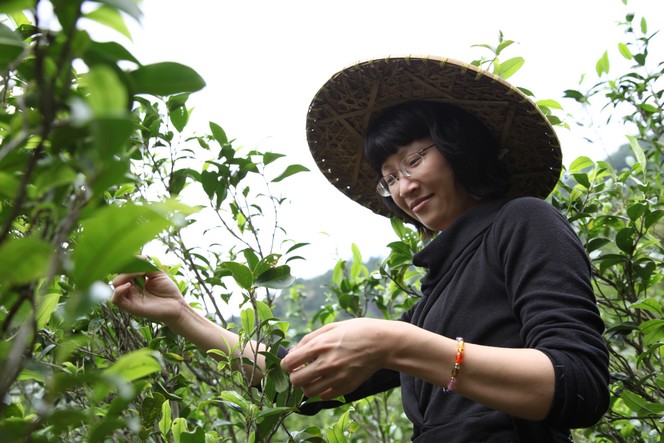
There are few places in the world where tea is harvested from full-sized tea plants. On most plantations the camellia bushes are maintained at waist height. However, in regions where Pu Ers are produced, as well as here on Feng Huang mountain (China), the leaves of large tea plants are considered to have a superior aromatic quality.
If you have never tasted them, I suggest you try Dan Cong Wu Long as well as the oxidised Dan Cong – both are exceptionally subtle. They come from these large tea plants and were plucked by Mrs Huang, pictured here hard at work.
Looking like a vineyard…
In southern China, on the slopes of Phoenix Mountain, tea bushes are planted on terraces due to the steep gradients. This way of organising tea bushes is quite a rare sight around the world. Here, it makes this tea plantation on a mountainside where some remarkable wu longs are grown look a bit like a vineyard.
Feng Huang Shan mountains, China
Have you ever tasted a Dan Cong tea? These famous wu longs are produced in Guangdong province (China), in the Feng Huang Shan mountains where I took this photo, facing in the direction of the sea.
Visiting Japan’s first tea gardens
It is worth visiting Japan’s first tea gardens. These ones were planted on the island of Kyushu, apparently around the 17th century. They are very small gardens, situated on the mountainsides. To visit them you must travel through dense forests, mainly made up of magnificent cryptomeria trees. You walk along a narrow, well-worn path and then, coming across a clearing, you discover a tea garden.
A stele worth a detour on the island of Kyushu
This stele may look unprepossessing, but for fans of Japanese teas it is worth a detour. The stone bears an inscription stating that it was in this place that the monk Eisai, who came from Long Jing in China, planted tea seeds he had brought with him. As for the rest, you can see the outlines of some Camellia Sinensis trees on the right. At the moment I’m on the island of Kyushu, near the city of Saga, where the story of Japanese tea began.
I should also mention that there are a few other similar stelae on the same mountain, bearing roughly the same inscription.