Japan

The delicate art of making tea canisters from cherry bark

7 May 2010
The delicate art of making tea canisters from cherry bark

During my recent journey to Japan which led me to the north of Honshu at the extreme south of Kyushu, I visited for the first time a lovely city deeply nestled among mountains covered with woods. This city is Kakunodate, located nearby Akita (I’m giving details for the people, like me, who enjoy poking their nose on a map and dream while pointing their finger on imaginary roads).

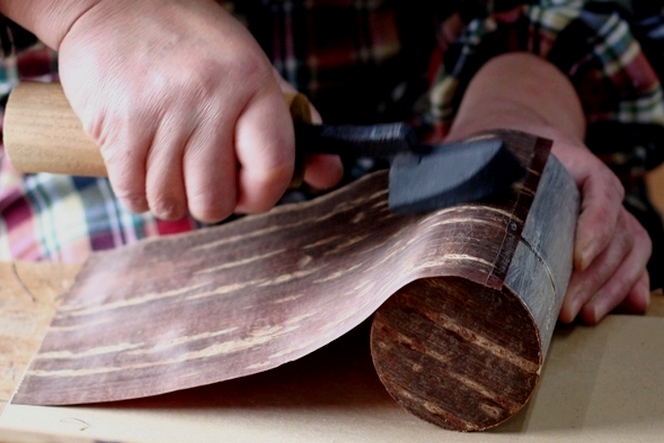
In Kakunodate the tradition of wood work is still carried on. But not any wood ! Here they are only interested in cherry tree. Objects are carved in its bark, or, in other words, this beautiful bark is turned into a smooth and delicate leaf just like a precious parchment and is then pinned against the desired object:  a tea canister for example.
It is a very slow and meticulous work: once the wet season is over, a sample of bark is taken (approximately ten meters above the ground) and is then left to dry for no less than a year ! This leaves enough time to carefully think about its destiny…

With the help of a small flat-iron, this worker smoothly presses against the bark, after having coasted its back so that it perfectly sticks to the tea canister’s body. Of course, before that, she slowly polished the bark with great care,  using the blade of a knife in a repetitive movement  so as to make it surprisingly soft.

I’m admiringly watching her, in the silence surrounding her workshop. Once the tea canister is finished, she strokes it and holds it out to me with a discreet pride and I’m thinking about the beautiful Japanese green tea which will be a perfect case for it.
Share on Facebook. Tweet this!

In Japan, the harvests of tea are also delayed

4 May 2010
In Japan, the harvests of tea are also delayed

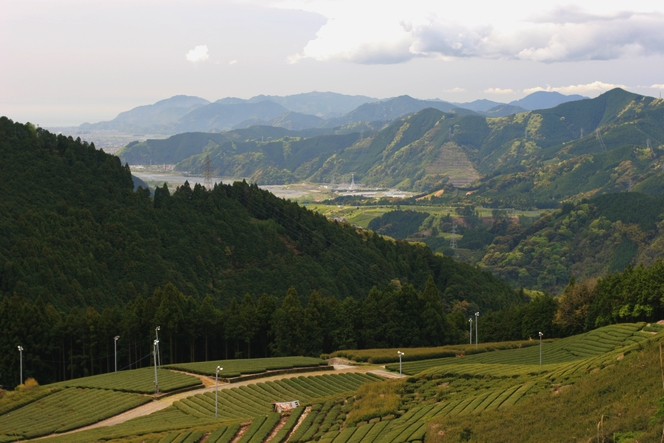
These days I was nearby Shizuoka, the main tea producing region of Japan. I took this picture in Tawaramine, a highly considered place for growing tea. Beyond the harmonious curve made by the row of tea trees, one can see the city of Shizuoka spreading out on the border of the Pacific.

The farmers of Tawaramine, just like the ones of the other surrounding mountains (Asahina, Hirayama…), don’t have much to complain this year. The harvesting of tea is of course very much delayed this year due to the cold weather of April and the shoots are only beginning to show up. However they do not have to experience the disaster of their colleagues located on the Makinohara plateau: because of a lower altitude and an early spring followed by a rough cold snap, the tea trees have simply frozen, and as a result the production of tea is partly compromised for them.

So from Darjeeling to Shizuoka, from Yunnan to Anhui and from Zhejiang to Fujian, the harvests are really delayed this year.

Share on Facebook. Tweet this!

Hisanori Masuda, designer de théières

23 February 2010
Hisanori Masuda, designer de théières

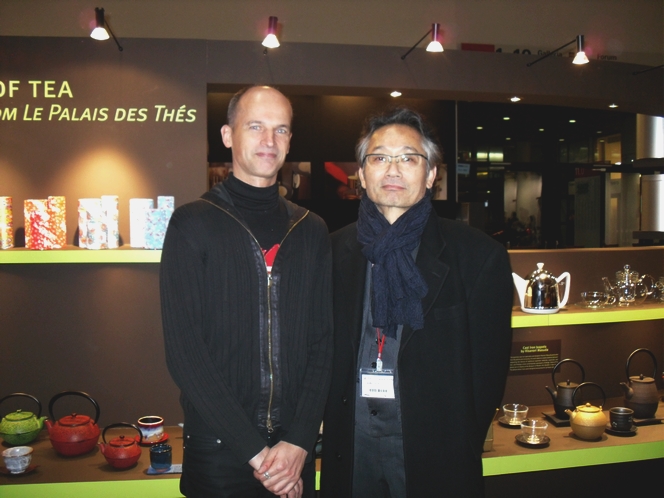
J’ai le plaisir de vous présenter mon ami Hisanori Masuda. Hisanori est un fameux designer Japonais qui a créé de très beaux modèles de théières en fonte. Il a exposé dans différents pays du monde (au MoMa, à New York, par exemple), et il enseigne à l’université au Japon. Nous nous connaissons depuis une quinzaine d’années grâce à Kayoko Nishikawa avec laquelle j’ai voyagé à plusieurs reprises dans le nord de l’archipel, notamment dans la province d’Iwate. C’est en effet dans cette région que l’on fabrique les théières en fonte. Encore aujourd’hui elles sont fondues une à une.
Hisanori a également dessiné de très beaux modèles de bouilloires, au design simple, rigoureux et traditionnel à la fois. Les théières Hikime, Chokaku et Natsume sont de parfaites illustrations de son travail.
J’ai retrouvé Hisanori la semaine dernière à Francfort lors du salon Ambiente. Il est venu sur le stand du Palais des Thés et j’ai pu le présenter à notre équipe qui avait hâte de faire sa connaissance. Cette photo a été prise à cette occasion.

Share on Facebook. Tweet this!

Tea plants around Mount Fuji

19 February 2010
Tea plants around Mount Fuji

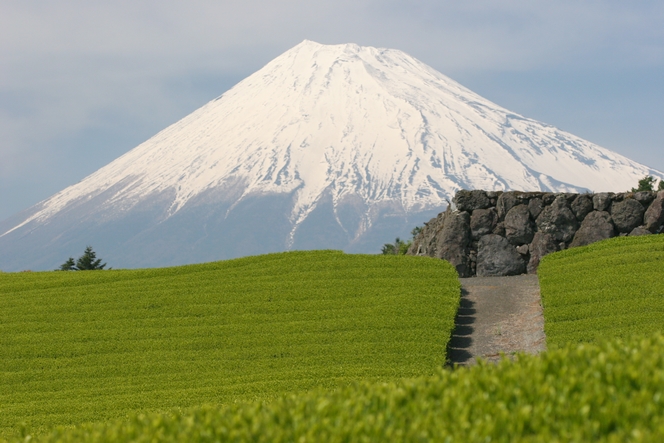
There are many tea plantations around this Japanese peak, but it’s not easy to find a spot where you can only see the tea garden with Mount Fuji in the background. You have to drive around the narrow back roads, keep turning round… It requires patience. And when you reach your goal, don’t expect solitude: the Japanese are keen photographers, and there is a real cult attached to their favourite volcano… There were at least a dozen Japanese around me when I took this photo.

Share on Facebook. Tweet this!