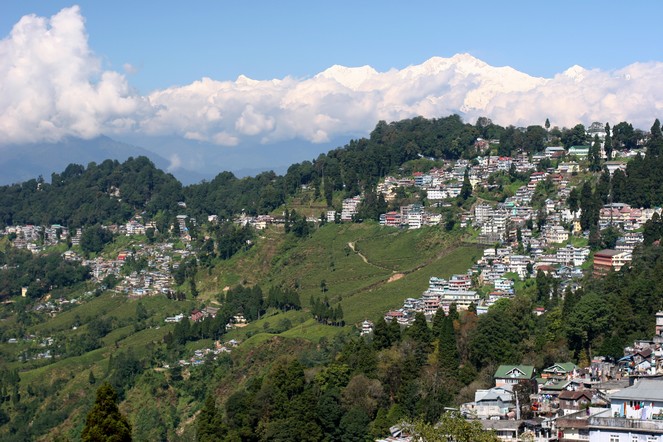
This is a rather idyllic view of Darjeeling: a charming town with plenty of green space, spread out among the tea plantations in the Himalayan foothills.
The reality is more complex: the city has more than 100,000 inhabitants and spreads out much further than can be seen here. The roads are crumbling, all the city’s water has to be trucked in, and the traffic increases every year, making it very congested.
India
Departure for India
This morning I took off for India.
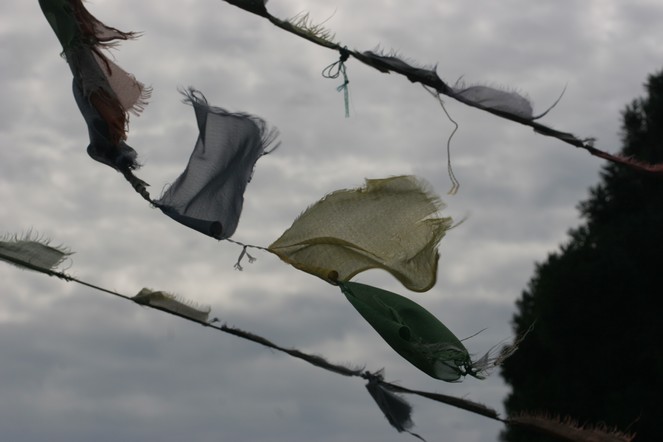
I’m not yet travelling on a prayer mat or on one of these flags fluttering in the wind, but that doesn’t mean I am not unmoved by the intense mystique of this country, its poetry.
These materials you see here symbolise the sky, the earth, water, fire and air, depending on their colour. On each of these flags are printed prayers that are carried off by the wind.
Trouble in Assam
The state of Assam (India), the country’s main tea-producing region, is going through a difficult period.
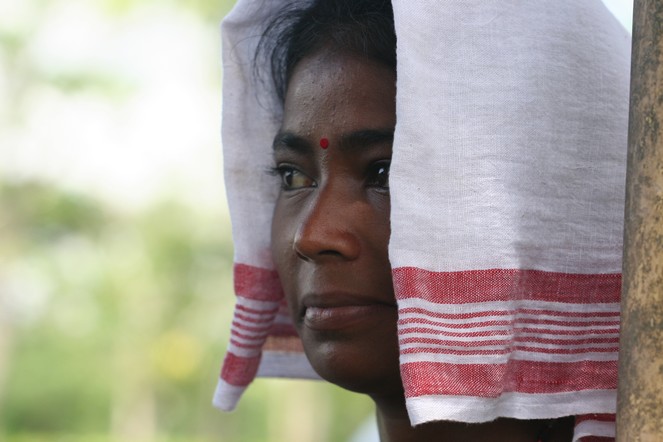
Security has been an issue here for years. I don’t want to go into the detail of the reasons behind the violence. I don’t know enough about it. I just want calm restored, like the lovely calm expression on this Assam tea plucker’s face.
The red and white fabric she wears wrapped around her head is typical of women in the region.
Tea Oxidation
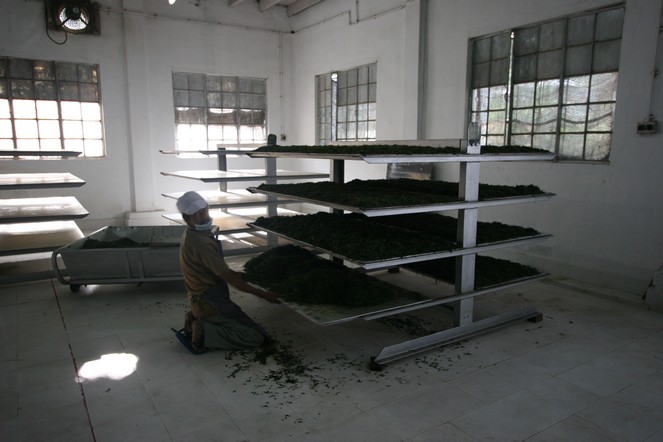
Oxidation is an important stage in the process of making black tea.
It is not very easy to photograph as it consists of spreading out the tea on sheets in a fairly warm and humid atmosphere, then simply waiting for time to pass.
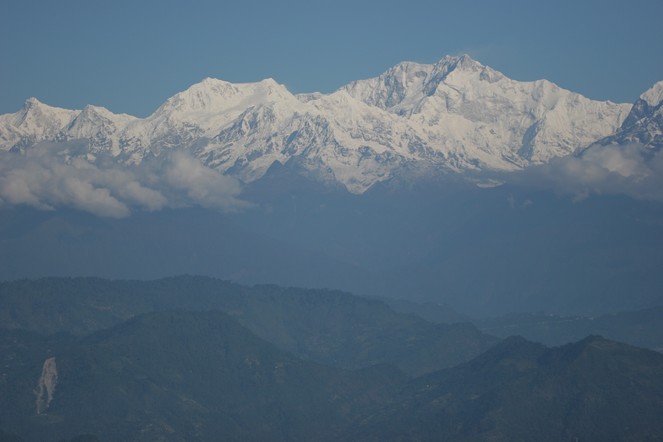
View of the Kanchenjunga range
While the sky is often overcast in Darjeeling during the summer months, it is often clear from the end of October.
It is then possible to admire the view of the Kanchenjunga range from the promenade that starts at Chowrasta, in the centre of the city.
The last autumn teas in Darjeeling
In a month’s time, the Darjeeling season will be over.
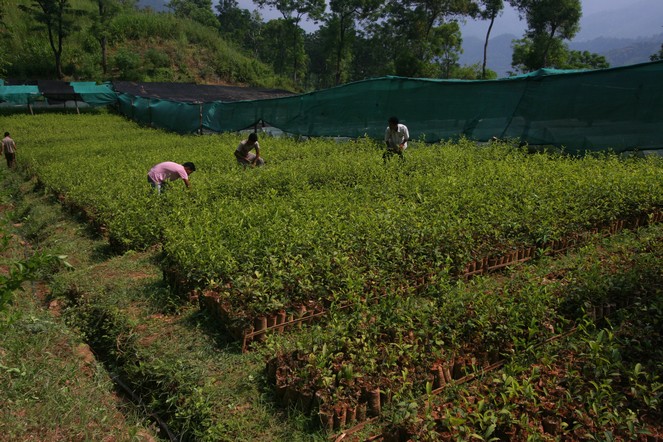
The temperature will drop and the tea plants will go dormant. Before then, a few autumn or “third flush” teas are still being produced, and there are other jobs to be getting on with, like here, at Delmas Bari, where the young shrubs are being tended to.
These ones are now big enough to leave the nursery and be planted out in the ground.
Expertise makes good tea
Because I visit the production regions regularly I am able to stay abreast of changes that take place on the plantations.
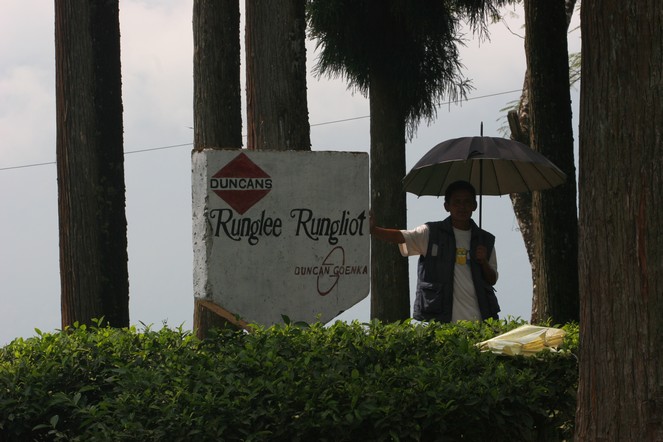
I’ll give you an example: today, a garden like Runglee Rungliot is completely unknown among the public, and justifiably so – it does not produce good tea.
But for things to change radically, all it needs is an experienced planter to come and work at the garden. The tea plants, the altitude, the orientation: this place has it all, and one day it will produce top quality teas.
The expertise of a planter in Darjeeling
Among the most experienced planters in Darjeeling, JD Rai is one of the best. I got to know him when he was in charge of the Margaret’s Hope estate.
This year I was delighted to see him again at the Thurbo plantation where he is now in charge. JD Rai is making some excellent teas there.
His expertise reaches beyond his own tea estate as he also supervises work on four or five other gardens.
And, unlike most planters in Darjeeling who come from the plains, JD Rai is from Darjeeling. He’s at home here.
People and itineraries crossing paths
Life is about meeting people, about trajectories that follow one another or cross paths. Life is a path.
I dedicate this photo to Emilie who has looked after my blog since it started. I record my thoughts, but it is Emilie who presents them so beautifully. She gives them titles. She also searches through my many photos, sometimes cropping one for better effect. And she gives my writing a second life on the social networks.
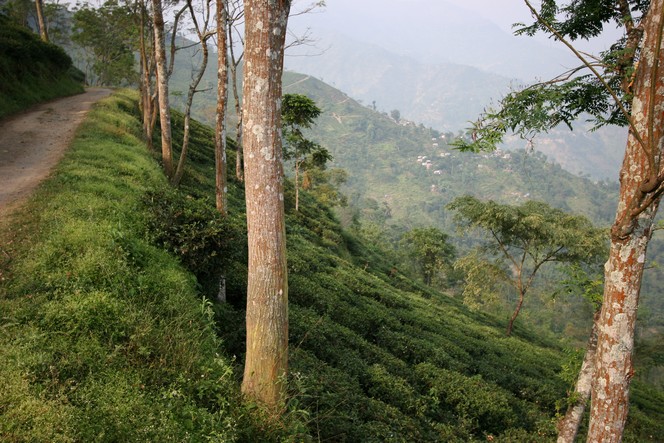
Emilie is now taking another path, and I’ll miss her. I’d also like to thank her for the quality of her work. I hope she enjoys the road ahead. And I hope it is as beautiful as this one, which winds its way between the tea plants towards Darjeeling.
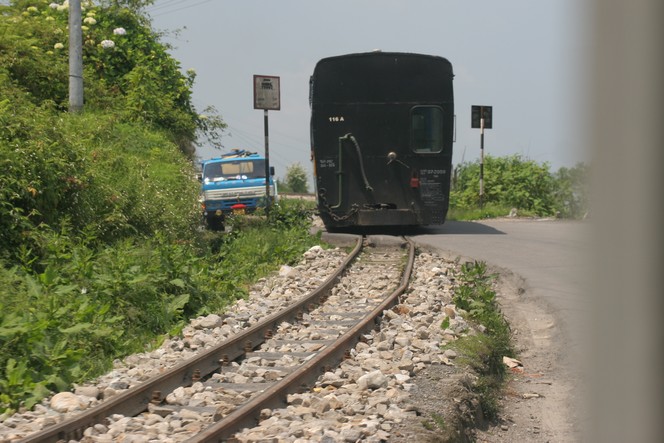
A familiar little train on my blog…
The little train of Darjeeling is a familiar sight on my blog. It comes and goes whenever it pleases, without so much as a by-your-leave. And it doesn’t just do this on my pages either: look how casually it makes use of the road when it fancies! Other vehicles have to watch out when this train is about.