From plant to cup

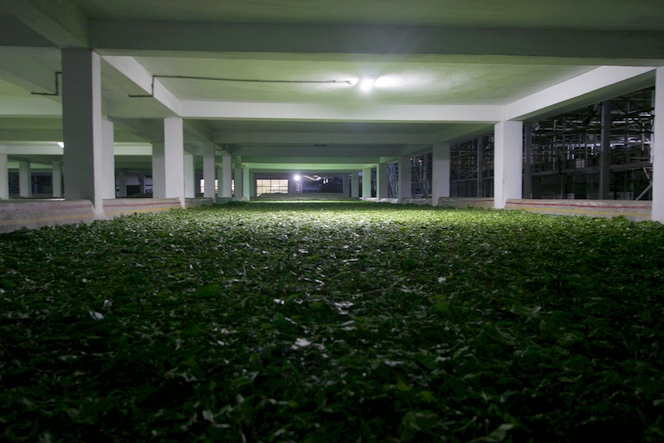
Tea leaves spread out as far as the eye can see

30 August 2011
Tea leaves spread out as far as the eye can see

In Assam, anything related to tea processing takes place on a massive scale, because of the incredible yield they get here: four times higher than in Darjeeling. The plantations themselves cover a much larger area than elsewhere in the country.

Take the withering, for example. Instead of troughs 10 to 15 metres wide, which I am used to seeing in other parts of India, here the leaves are spread out as far as the eye can see. I took this photo at night, and the dim light adds to the mystery of this essential stage in tea processing. During the withering, the leaf will lose much of its water content (up to 40% for Assams; up to 70% for Darjeelings).

Share on Facebook. Tweet this!

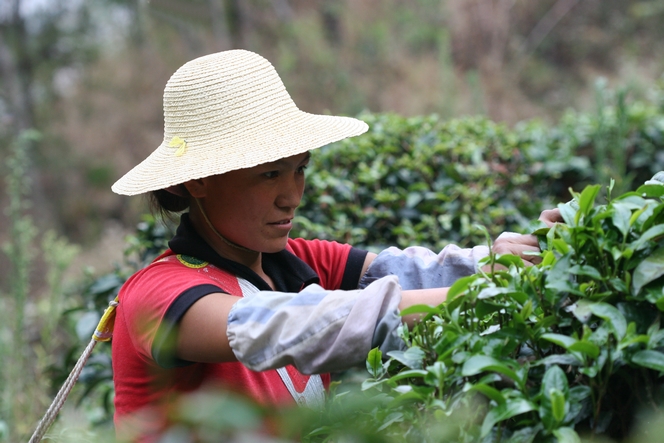
Camellia : a shrub with a tough foliage

23 August 2011
Camellia : a shrub with a tough foliage

In many countries, the men and women who pluck tea leaves wear a type of sleeve made from a light canvas, which covers part of the arm.

Camellia is quite a tough shrub, and at the end of the day, without this protection, which can be worn directly on bare skin or over the top of a garment, the pluckers’ arms would be covered in scratches.

I expect this young woman from Yunnan, who looks rather stylish beneath her straw hat, would agree.

Share on Facebook. Tweet this!

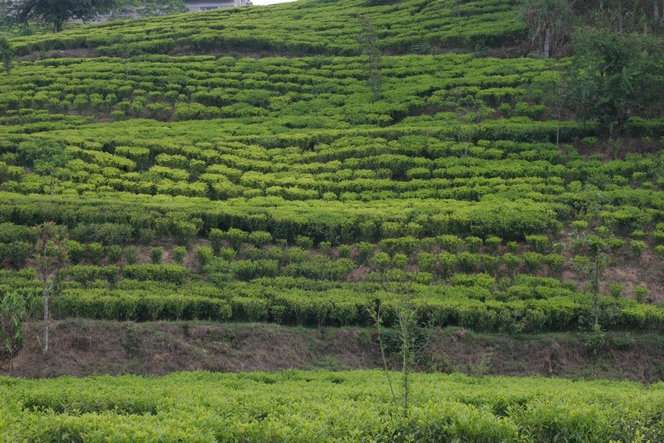
Tea trees growing quite freely in Kuwapani

16 August 2011
Tea trees growing quite freely in Kuwapani

I am very aware of how lucky I am to be able to spend several months a year walking through tea fields. I never tire of it. Each tea plantation looks different. Some slope, others are flat, some are densely planted, others sparsely. Some are wooded, but the trees vary from one region to another.

What I like about this photo taken on Kuwapani Tea Estate (Nepal) is the contrast in these tea trees planted in rows that are quite orderly, yet which leave room for some interesting effects. The wavy lines follow the irregularities of the terrain, with a certain sense of freedom. They have adapted to their environment. We can see how the hand of man has marked out a neat line, and nature, rebellious, has ignored it.

Share on Facebook. Tweet this!

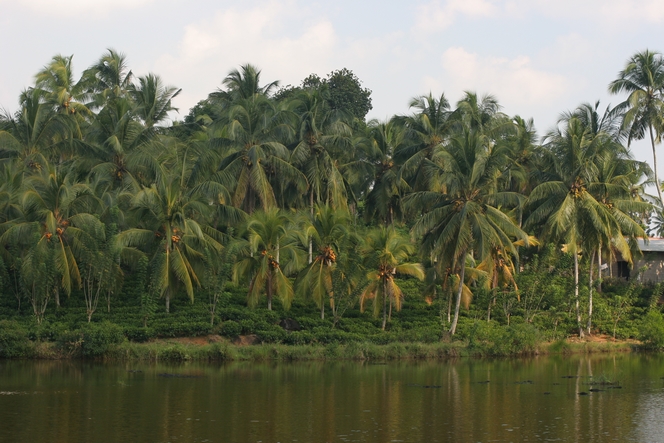
Palm trees giving shade to tea plants

12 August 2011
Palm trees giving shade to tea plants

Here, in the south of Sri Lanka, in the “low grown teas” region, the sun is very intense, and it is best to protect the tea plants from its rays for at least a few hours a day.

Curiously, palm trees are used here to provide shade, despite being a rarity. As the palm trees themselves are cultivated, this enables the farmer who owns this lovely lakeside plot to harvest two different products on the same land, and both plants benefit.

Share on Facebook. Tweet this!

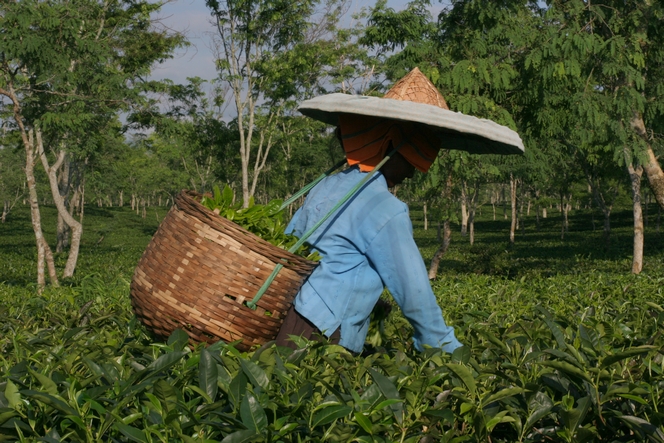
Plucking tea with 35°C and 100% humidity

29 July 2011
Plucking tea with 35°C and 100% humidity

When you know what the climate is like here in Assam, you realise this woman must be brave to work outside. Throughout my stay in the Jorhat region, the temperature varied between 35° and 38°C, while the humidity came close to 100%.

Whatever the temperature, she rarely removes her wide-brimmed hat: it protects her from the powerful rays of the sun and also from the frequent and torrential downpours that can come at a moment’s notice.

Share on Facebook. Tweet this!

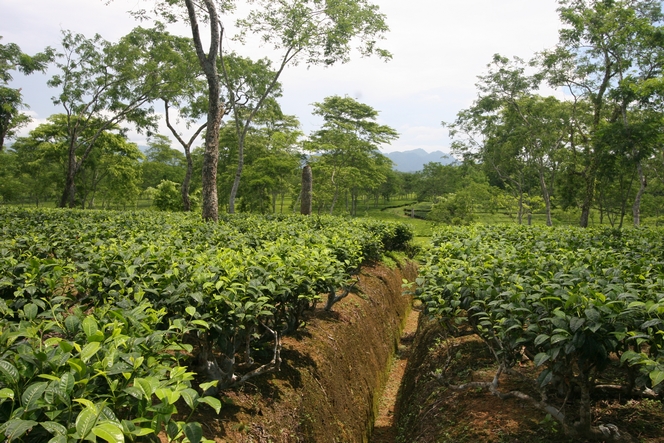
Drains dug into the soil to protect tea plants

22 July 2011
Drains dug into the soil to protect tea plants

The tea plant enjoys humidity, but it hates having water sitting around its roots. How awkward! To keep its feet dry when the ground is flat, like here in Assam, drains are dug into the soil.

Switching locations from the plains to the peaks, I want to tell you about the mountain blocking my view right now. It marks the start of Nagaland, the sparsely populated region that borders Assam. The Nagas are a friendly people, but due to one of their ancient customs, thankfully now abandoned, they are sometimes known as “Head Cutters”.

Share on Facebook. Tweet this!

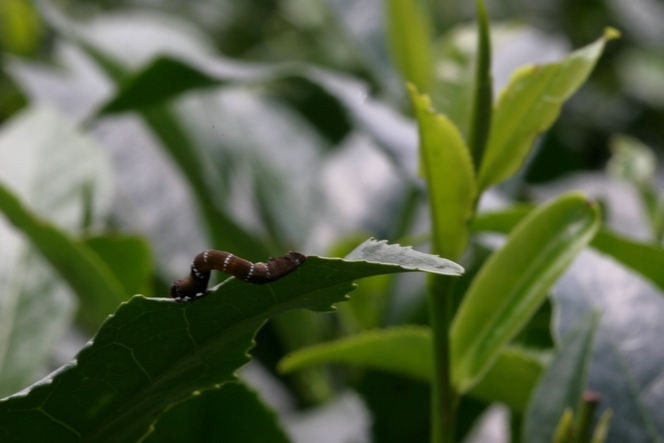
The inchworm is an enemy of the tea plant

19 July 2011
The inchworm is an enemy of the tea plant

Among the enemies of the tea plant, the inchworm features in prime position. With a ferocious appetite, it can munch its way through quite a few leaves in a short space of time. Getting rid of them isn’t easy, especially on organic plantations. Birds are the principle predators of this creature, whose name derives from its strange gait: it advances by taking calculated “steps”, measuring out each one with apparent expertise.

Share on Facebook. Tweet this!

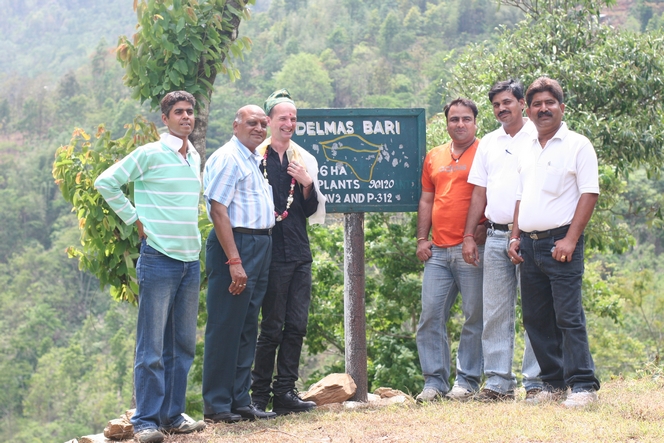
“Delmas Bari” : a tea plantation named after me

15 July 2011
“Delmas Bari” : a tea plantation named after me

One day, when I was in Darjeeling, I was surprised to find that a plot on the North Tukvar plantation had been named after me. It was a new plot, mainly planted with the AV2 cultivar which I am particularly fond of.

This gesture from G. Somani, superintendant of North Tukvar and Puttabong, touched me greatly, and from time to time I return to “Delmas Bari”. The tea plants have grown, they look magnificent at the moment. The place has a unique charm about it. A small stand provides shade where you can enjoy a cup of tea and take in the incredible beauty  and utter tranquillity of the surroundings. I feel quite at home there!

Share on Facebook. Tweet this!

Machines used in the tea bag industry

8 July 2011
Machines used in the tea bag industry

Assam tea plantations are unusual in that they produce “orthodox” tea, processed according to the traditional method, but they also produce “CTC” tea, which stands for “cut, turn, curl”. CTC tea has none of the qualities of a fine tea. It is produced by machines, which I have photographed for you. This tea doesn’t interest me much, and for good reason: one of its uses in the tea bag industry is to bring colour quickly to the cup and express strength.

Nonetheless, the process of making CTC tea is interesting: as it passes through the various machines, the leaf gradually gets smaller and smaller until it is just a tiny round ball.

Share on Facebook. Tweet this!

Charming tea plucker on Dufflating Tea Estate

5 July 2011
Charming tea plucker on Dufflating Tea Estate

The yield per hectare here in Assam is four times higher than in Darjeeling, and totals two tonnes a year. Each tea plant produces such a quantity of leaves that between March and November, the shoots on each bush are plucked at least once a week. A record! Yet this charming tea plucker on the Dufflating Tea Estate does not seem overwhelmed by the scale of the task; in fact she looks quite happy.

Share on Facebook. Tweet this!